

The AI Visibility ROI Framework: How to Scale Revenue from AI Search in 2026
 Catalin Dinca
Every marketing leader has had some version of the same conversation in 2026. Someone on the team proudly reports that the brand was mentioned in a ChatGPT answer, or cited in a Perplexity response, or surfaced in a Google AI Overview. The room nods. Then someone asks the question that actually matters: so what did that do for revenue?
Most teams cannot answer that question with any confidence. They can show a screenshot of a citation. They cannot show a number that a CFO would accept. That gap is not a measurement inconvenience — it is the single biggest reason AI visibility budgets stall out after the first pilot quarter, even when the underlying strategy is working.
This is the playbook for closing that gap: how to define AI visibility ROI in terms finance will actually accept, how to build the tracking to support it, and how to use what you learn to optimize spend and scale it with confidence.
Why AI Visibility ROI Is Harder to Prove Than SEO ROI
Traditional SEO ROI, whatever its flaws, has one thing going for it: a click. A user searches, clicks a blue link, lands on your site, and every analytics tool ever built is designed to pick up the trail from there. Attribution is imperfect, but it is a solved problem in the sense that the infrastructure exists.
AI visibility breaks that chain in three specific ways.
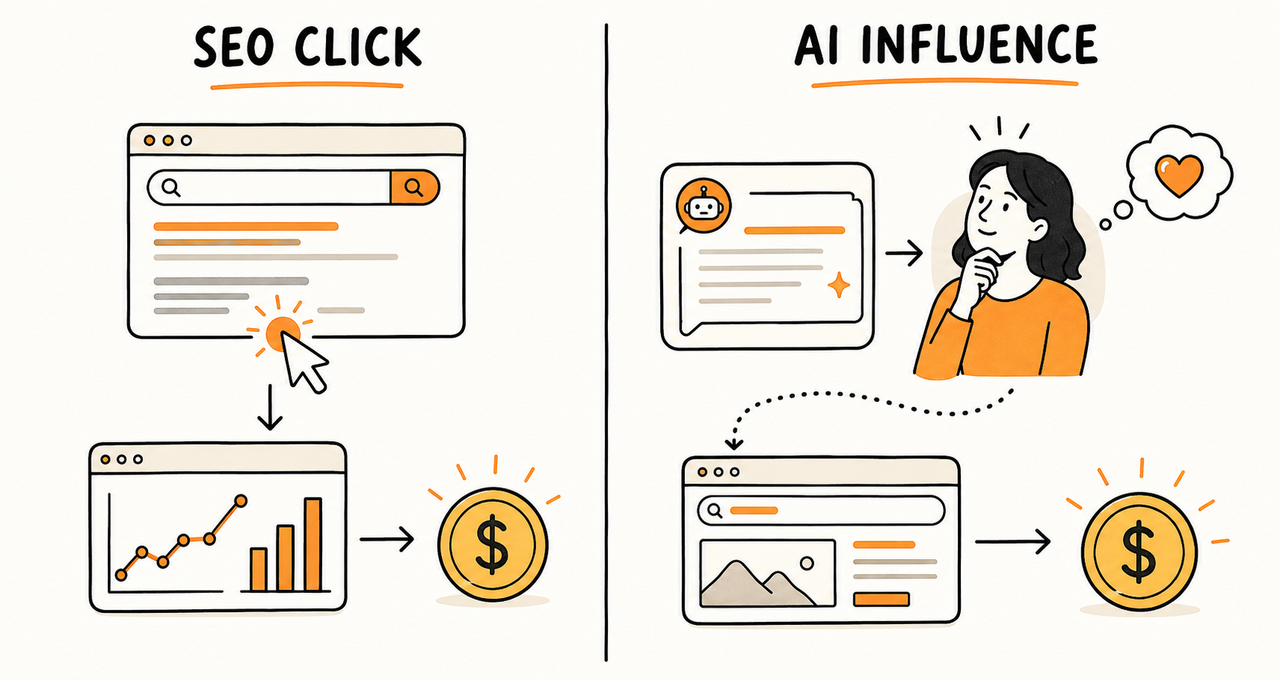
The interaction often produces no click at all. When ChatGPT answers a question by summarizing your product and naming two competitors, the user gets their answer inside the chat window. There is no referral, no UTM parameter, no session in Google Analytics. The influence happened, but it left no trace in the systems most teams use to measure everything else.
The citation is probabilistic, not positional. A page either ranks #3 for a keyword or it does not — that is binary and stable enough to track daily. Whether your brand gets named in a given AI answer depends on the model, the exact phrasing of the prompt, the user's location, conversation history, and which version of the model answered that day. The same prompt can produce different answers an hour apart. You are measuring a probability distribution, not a rank.
The value shows up downstream, disconnected from the moment of citation. Someone reads an AI summary that mentions your brand on Monday, forgets about it, and types your brand name directly into Google on Thursday. Every analytics tool will record that Thursday visit as direct or organic-branded traffic. None of them will connect it back to the AI answer that planted the idea three days earlier.
None of this means AI visibility ROI is unmeasurable. It means it needs a different measurement model than the one built for search engine clicks — one built around layers rather than a single funnel.
The Three Layers of AI Visibility ROI
Trying to measure AI visibility ROI as one number is where most teams go wrong. It works better as three connected layers, each with its own metrics, each feeding the one below it.
Layer 1: Presence. Are you showing up at all, and how does that compare to competitors? This layer answers whether you exist in the conversation before it even gets to whether that presence is doing anything.
Layer 2: Influence. When you do show up, is the mention favorable, accurate, and positioned well relative to competitors? Presence without favorable framing is not worth much — being named as the fourth option in a list of five is a very different outcome than being named as the recommended pick.
Layer 3: Outcome. Is any of this connected to pipeline, signups, or revenue? This is the layer finance actually cares about, and it is the hardest to instrument, but it is only measurable at all once layers one and two are tracked consistently enough to correlate against.
Skipping straight to layer three — trying to prove revenue impact before you have any consistent presence or influence data — is why most AI ROI attempts collapse. You cannot correlate revenue against a signal you are not tracking cleanly.
The Metrics That Actually Map to Each Layer
AI Visibility Score. A composite measure of how often and how prominently your brand appears across a defined set of prompts relevant to your category, tracked across ChatGPT, Perplexity, Gemini, and Google AI Overviews on a consistent cadence. This is your layer-one baseline. Without a stable, repeatable prompt set tracked over time, every other metric downstream is noise.
Share of Model Voice. Of all the brand mentions that appear across your tracked prompt set, what percentage are you versus each named competitor? This reframes visibility as a competitive share metric rather than an absolute number, which is what finance teams are already used to thinking in terms of from market share reporting.
Citation Sentiment and Position. Not every mention is equal. Track whether your brand is described accurately, whether it is recommended or merely listed, and where it appears in the answer — first-mentioned brands are cited and clicked through at meaningfully higher rates than those buried in a longer list.
AI Referral Traffic. The portion of AI-driven traffic that does leave a trace — clicks from Perplexity's cited sources, from ChatGPT's browsing links, from AI Overview citations. Most analytics platforms can now segment this as a distinct channel if you set it up deliberately rather than letting it fall into "referral" or "other."
Branded Search Lift. Track branded search volume and direct-navigation traffic against your AI visibility score over time, by cohort and by launch of new AI-visible content. A rising branded search trend that correlates with rising AI presence, with no other explanation available, is meaningful evidence even without a clean click-path.
Assisted Conversions. In any CRM or analytics setup that supports multi-touch attribution, add an explicit "referenced AI tool in conversation" or "mentioned finding us via ChatGPT" field to sales and onboarding conversations. This is manual, it does not scale perfectly, and it is still the single most reliable revenue signal most teams will get in 2026, because it comes directly from the buyer instead of being inferred from a session log.
A Practical Framework for Calculating AI Visibility ROI
Here is the sequence that turns those metrics into a number you can defend in a budget meeting.
Step 1: Establish your prompt baseline. Build a fixed list of 20 to 50 prompts that real buyers would plausibly type into an AI assistant when researching your category — not brand-name prompts, category and problem prompts. Run them consistently across platforms on a fixed schedule, not ad hoc.
Step 2: Score presence and share of voice monthly. Track your AI Visibility Score and Share of Model Voice against the same prompt set every month. Consistency of the prompt set matters more than the size of it — a stable 30-prompt panel tracked for six months tells you more than a one-time sweep of 500 prompts.
Step 3: Instrument every traceable AI referral. Set up a distinct channel grouping in your analytics for AI-referred traffic, separate from generic referral or organic. Tag it wherever the platform allows attribution parameters, and treat it as its own line in every report from day one.
Step 4: Layer in branded search and direct traffic as a secondary signal. Track the trendline, not a single data point. A single month of higher branded search proves nothing. A six-month trend that rises alongside your AI Visibility Score, without a competing explanation like a paid campaign or press event, is a defensible correlation.
Step 5: Add the qualitative signal from sales and support. Even a simple, consistently asked question — "how did you first hear about us?" — with an AI-assistant option in the dropdown, produces a real number over a quarter. It will undercount, because most buyers will not remember or mention it unprompted, but a stable undercount tracked consistently is still directional and improving over time.
Step 6: Calculate a blended ROI estimate, not a precise one. Combine traceable AI referral conversions, a conservative attribution slice of the branded search lift, and the self-reported assisted conversions into a single revenue estimate. Present it as a range with your assumptions stated explicitly, not as a single misleadingly precise figure. A defensible range that finance can interrogate builds more long-term trust than a clean number that falls apart under one follow-up question.

Three Scenarios Showing How the Math Plays Out
A B2B SaaS company. A mid-market project management tool tracks 35 category prompts monthly across three AI platforms. Over two quarters, their AI Visibility Score rises from a baseline as new comparison and use-case content goes live. AI-referred traffic stays small in absolute terms — a few hundred sessions a month — but converts at a noticeably higher rate than average organic traffic, because the users arriving already had their initial questions answered by the AI and are further along in evaluation. Combined with a steady rise in branded search and a growing count of "found you through ChatGPT" mentions logged by sales, the blended estimate shows AI visibility contributing a small but consistently growing slice of new pipeline — enough to justify a second quarter of investment, which is the actual decision the measurement needs to support.
An ecommerce brand. A specialty retailer finds that AI-referred sessions are rare but unusually high-intent: users arrive having already had product comparisons summarized for them, and add-to-cart rates from that segment outperform paid search. The ROI case here is not built on volume. It is built on showing that a small, high-converting channel is growing quarter over quarter, which changes the investment conversation from "is this worth doing" to "how do we get more of this specific segment."
A local services business. A regional business finds close to zero traceable AI referral traffic, because local AI answers rarely produce clickable citations at all. The ROI case has to lean almost entirely on branded search lift and direct calls, cross-referenced against new content and citation-building activity. It is the weakest attribution case of the three, and the honest conclusion is to treat AI visibility as a brand-awareness investment measured in impressions and mention share for this business type, not a direct-response channel — which is itself a useful, defensible finding.
Common Mistakes That Undermine AI ROI Measurement
Tracking brand-name prompts only. Asking "what is [your brand]" and confirming the AI knows who you are proves nothing about whether you show up when a buyer who has never heard of you is comparing options. Category and problem prompts are the only ones that matter for new-pipeline attribution.
Changing the prompt panel every time you measure. If your tracked prompts shift month to month, you cannot tell whether a visibility change is real or an artifact of a different sample. Lock the panel, review it quarterly, and change it deliberately rather than casually.
Demanding a single-touch attribution model. AI visibility is functionally closer to brand advertising or PR than to paid search in how it influences buyers — the impact compounds across touches rather than resolving to one clickable moment. Measuring it with a last-click model will always undercount it, sometimes to zero.
Reporting citation counts without competitive context. A rising number of mentions means little on its own. The number that matters is your mentions relative to named competitors across the same prompt set, tracked over the same window.
Waiting for perfect attribution before reporting anything. The businesses that get sustained AI visibility budget are the ones that start reporting a defensible, improving, range-based estimate early and refine it, not the ones that wait for a flawless model that will not arrive.
Turning Measurement Into Optimization
Once the measurement layer is running, it tells you exactly where to spend the next dollar, which is the actual point of building it.
If your AI Visibility Score is flat despite new content, the problem is usually structural: your content is not written in a form AI systems can confidently extract and cite — buried claims, inconsistent entity naming, no clear original data or point of view. Fix the structure and clarity before adding volume.
If your Share of Model Voice is strong but Citation Sentiment is weak — you are mentioned often but rarely recommended — the gap is usually trust and depth signals: case studies, original research, and third-party validation that give the model a reason to recommend you rather than just acknowledge you exist.
If presence and sentiment are both strong but AI referral traffic and branded search are not moving, look at whether the AI answers are actually resolving the user's need without a click. In some categories that is unavoidable, and the honest response is to shift the ROI framing toward brand lift rather than direct response, as in the local-business scenario above.

How FluxSERP Supports the Full Measurement Loop
Building this measurement framework by hand — running prompt panels manually, screenshotting AI answers, cross-referencing analytics segments — does not scale past a handful of prompts a month. FluxSERP is built to run the entire loop continuously.
The AI Visibility Analysis tracks your AI Visibility Score and Share of Model Voice across ChatGPT, Perplexity, and Gemini against a consistent, ongoing prompt panel, so layer-one and layer-two data accumulates automatically instead of depending on someone remembering to run a manual check.
Source Attribution shows exactly which of your pages are being cited when your brand comes up, so you can see which content is doing the work and which category prompts still return no mention of you at all — the clearest possible to-do list for closing visibility gaps.
Competitor Intelligence puts your Share of Model Voice in context against named competitors on the same prompt set, so a rising mention count is reported as what it actually is: gaining share, holding share, or losing it.
AI Recommendations turns the gaps identified across all of this into prioritized content and structure actions, so the optimization step described above happens continuously rather than as a quarterly scramble.
Combined with Rank Tracking on the traditional SEO side, FluxSERP gives you the presence and influence layers in one dashboard — the foundation every revenue-layer estimate in this playbook depends on.
Frequently Asked Questions
Can you get exact revenue attribution for AI visibility? Not with the same precision as a last-click paid search campaign, and treating any tool that claims otherwise with skepticism is reasonable. What you can build is a defensible, improving range built from traceable referrals, correlated branded search lift, and self-reported buyer signals — which is enough to make and justify budget decisions.
How long before AI visibility ROI shows up in the numbers? Most teams need at least two full quarters of consistent tracking before a trend is distinguishable from noise, because both the AI Visibility Score baseline and the branded search correlation need enough data points to be meaningful. Expect the first quarter to be almost entirely about establishing the baseline, not proving impact.
Should AI visibility ROI be measured against the same targets as SEO? No. Use SEO's click-and-conversion targets for SEO. Use presence, share of voice, and brand-lift targets for AI visibility in its early stages, and only introduce direct revenue targets once traceable AI referral volume is large enough to be statistically meaningful on its own.
What is the single highest-leverage metric to start with if we can only track one thing? Share of Model Voice against a fixed category prompt panel, tracked monthly against named competitors. It requires the least instrumentation, it is immediately comparable to a metric finance already understands from market-share reporting, and it is the leading indicator every other layer in this framework depends on.
Key Takeaways
AI visibility ROI cannot be measured the way SEO ROI is measured, because the interaction often produces no click, the citation is probabilistic rather than positional, and the value frequently shows up days later in a completely different channel. Trying to force it into a last-click model is why most measurement attempts fail before they produce anything useful.
The framework that works treats ROI as three layers — presence, influence, and outcome — each measured with its own metrics, each feeding the one below it. Presence and share of voice against a locked, consistent prompt panel is the foundation everything else depends on.
A defensible, range-based revenue estimate, built from traceable AI referrals, correlated branded search lift, and self-reported buyer signals, is enough to justify and scale a budget in 2026. Waiting for perfect single-touch attribution is not a measurement strategy — it is a way to guarantee the budget gets cut before the strategy has a chance to prove itself.
FluxSERP builds the presence and influence layers automatically, continuously, and in competitive context, so the measurement loop this playbook describes runs in the background instead of consuming a full-time analyst's month every quarter.

Catalin Dinca
Written by Catalin Dinca