

How to Find Keywords Your Competitors Are Ignoring (A Practical 2026 Guide)
 Catalin Dinca
Most keyword research fails before a single word is written.
The standard approach goes like this: open a tool, sort by the lowest difficulty score, pick whatever has the highest search volume, and hit publish. Six months later, nothing is ranking and SEO gets the blame.
The fault does not lie with the tools. It lies with the assumptions behind how they are used.
In 2026, keyword research cannot simply hunt for terms that appear easy in a spreadsheet. You need topics where genuine demand exists, where the current ranking pages can be displaced by your specific site, and where your content can address the core question plus the natural follow-up questions better than what is already there.
That is exactly what this guide delivers. Not theory. A complete, practical workflow for finding low-competition keywords that genuinely produce rankings and traffic — including the ones your competitors have systematically overlooked.
What "Low Competition" Actually Means in 2026
Drop the assumption that a low keyword difficulty number automatically equals a ranking opportunity.
Every major SEO tool calculates keyword difficulty differently. Some base the score almost entirely on the backlinks pointing to current top-ranking pages. Others factor in domain authority signals, content depth, and search intent alignment. When you compare a difficulty score of 15 from one tool against a difficulty score of 15 from another, you are holding up two different rulers. The numbers look the same. The math behind them is not.
The more useful definition of low competition has nothing to do with any score. A keyword qualifies as genuinely low competition when the current search results can be outranked by your site, given your current authority, your content production capabilities, and the page format the search results are clearly demanding.
Think of every keyword as a small marketplace. Searchers represent demand. The pages currently ranking represent supply. You win when there is enough demand to justify the investment, but the existing supply is weak, outdated, mismatched, shallow, or incomplete enough that your page can carve out a position.
In practical terms, a keyword is worth pursuing when five conditions line up simultaneously:
- It connects directly to what your site actually covers
- The search intent matches a page format you can realistically produce
- The current results are achievable given your domain authority
- The query offers genuine click potential and is not entirely absorbed by AI answers
- The keyword belongs to a wider topic cluster that can compound into more rankings over time
Break even one of those conditions and the opportunity deteriorates quickly. A keyword with 5,000 monthly searches but unbeatable incumbents is a poor target. A keyword with a difficulty score of 5 but no connection to your business is a waste of time. A keyword where the results clearly demand a free tool or interactive calculator but you plan to publish a blog post will not rank regardless of how well optimized it is.

Why Standard Keyword Research Keeps Producing Mediocre Results
Before walking through the step-by-step workflow, it is worth understanding exactly why the default approach fails so consistently. Five blind spots catch nearly everyone.
Difficulty Scores Do Not Account for Your Specific Site
A keyword with a difficulty score of 12 might be genuinely easy for a site with two years of topical authority built up in a specific niche. The exact same keyword could be completely unrankable for a brand-new domain with no backlinks and no existing content around the topic. The score does not know the difference. You have to.
The practical implication is that you cannot rely on difficulty scores as your primary filter. They are useful for quickly eliminating the most obviously competitive keywords from a large list. They are not useful for making final ranking decisions. That step requires examining the actual search results.
Search Volume Does Not Equal Traffic
Search volume tells you how many times a term is searched. It does not tell you how much traffic your page will actually receive if it ranks.
In 2026, AI-generated answer summaries, featured snippets, shopping carousels, forum threads surfaced by Google, and People Also Ask boxes absorb a significant percentage of clicks on many queries. A keyword showing 8,000 monthly searches might deliver only 1,500 actual clicks to organic results. A keyword with 400 monthly searches might deliver 360 clicks because the results page is clean and uncluttered.
Volume is a starting indicator, not a traffic guarantee. Always check what the actual results page looks like before committing to a keyword target.
One Page Cannot Win on One Keyword Alone
Google regularly ranks a single strong page for dozens or hundreds of related queries simultaneously when that page covers a topic with genuine depth and completeness. The old habit of mapping exactly one keyword to exactly one page is leaving significant ranking opportunities untouched.
Modern keyword strategy should be built around topic clusters, not isolated phrases. Covering a subject comprehensively — addressing the primary question, the natural follow-up questions, the common objections, and the related subtopics — is now a baseline expectation for competitive rankings, not a differentiator.
Search Console Shows You Only Part of the Picture
Google Search Console is an invaluable keyword research resource, but it has documented limitations. It only shows non-anonymized query strings, it retains only the top rows of data rather than every row, and it can omit long-tail query data when you filter or group results.
If Search Console is your only keyword research source, you are working from a useful but incomplete view of your actual opportunity. A meaningful portion of the long tail is hidden from you by default.
AI Tools Generate Ideas, Not Validated Keywords
AI assistants are genuinely useful for expanding a seed list of keyword ideas quickly. They are not useful as a replacement for actual keyword research. They lack live search data, they cannot tell you whether the current results for a term are actually beatable, and they have no way to evaluate whether a keyword belongs to a cluster with real commercial potential. Use AI to widen your pool of ideas. Use live search results and keyword tools to make the actual selection decisions.
The Step-by-Step Workflow for Finding Keywords Competitors Miss
This is the core of the guide. Six steps, in sequence, that take you from a blank page to a validated list of keywords you can realistically rank for — including the ones your best competitors have skipped entirely.
Step 1: Start With Customer Problems, Not Broad Topics
Keyword research should begin by stepping into your customers' shoes, not by typing a broad category term into a tool and sorting by volume.
Before opening any research platform, list out the specific problems, desired outcomes, common objections, comparison questions, and edge cases your target audience actually deals with. The goal is to produce a list of specific situations, not a list of generic topics.
Do not start with "project management software." Start with "project management software for two-person creative studios," "how to track client approval rounds without losing files," "best project management tool for video production agencies," or "how to manage scope creep with retainer clients."
Specificity is where low competition almost always lives. The more precisely a keyword describes a real situation a real person is dealing with, the fewer competing pages exist that address it with the same precision.
When your initial ideas run dry, modifier banks help you generate new angles systematically:
| Modifier Type | Examples |
|---|---|
| Audience | for agencies, for churches, for solo founders, for two-person teams |
| Use case | onboarding, renewals, quarterly reviews, recurring projects |
| Comparison | vs, alternative to, better than, migrate from |
| Integration | with Slack, with QuickBooks, for Shopify stores |
| Geography | in Austin, near downtown, same-day, emergency |
| Constraint | free, no-code, template, checklist, under budget |
Long-tail keywords tend to be easier to rank for because their specificity attracts fewer competing pages and less optimization effort from established sites. Specificity matters more than any rigid rule about keyword length.
Step 2: Expand Your List From Four Proven Sources
Once you have your seed ideas, expand them systematically. Four sources consistently produce the strongest candidates for low-competition targeting.
Source A: Keyword research tools. This is the fastest route from one seed idea to dozens of candidates. The primary value of keyword tools is not the difficulty score — it is the ability to discover variations, related queries, and search volume data you would not have found through intuition alone.
Source B: Competitor keyword gaps. Keyword gap analysis is one of the most efficient shortcuts in SEO research. You start with keywords your competitors are already ranking for because those terms have proven demand. You are not creating demand from nothing — you are reverse-engineering what already works. The critical nuance is identifying your real search competitors, which are the pages winning the searches you want, not necessarily the businesses selling similar products.
Source C: Google Search Console. Search Console shows you the keywords Google already associates with your site. These are often the fastest wins available because Google is already serving your pages for these queries — you just need to improve enough to earn more clicks. Focus specifically on queries where your pages are generating impressions but ranking below position 10, and on non-branded queries where growth potential exists.
Source D: Real language from communities. Forums, Reddit threads, YouTube comments, Quora questions, and niche community platforms surface phrases that keyword databases have not yet fully indexed. This is where you discover the exact language real people use when they are confused, frustrated, or actively evaluating options. It is also where you find emerging topics before competitors do.
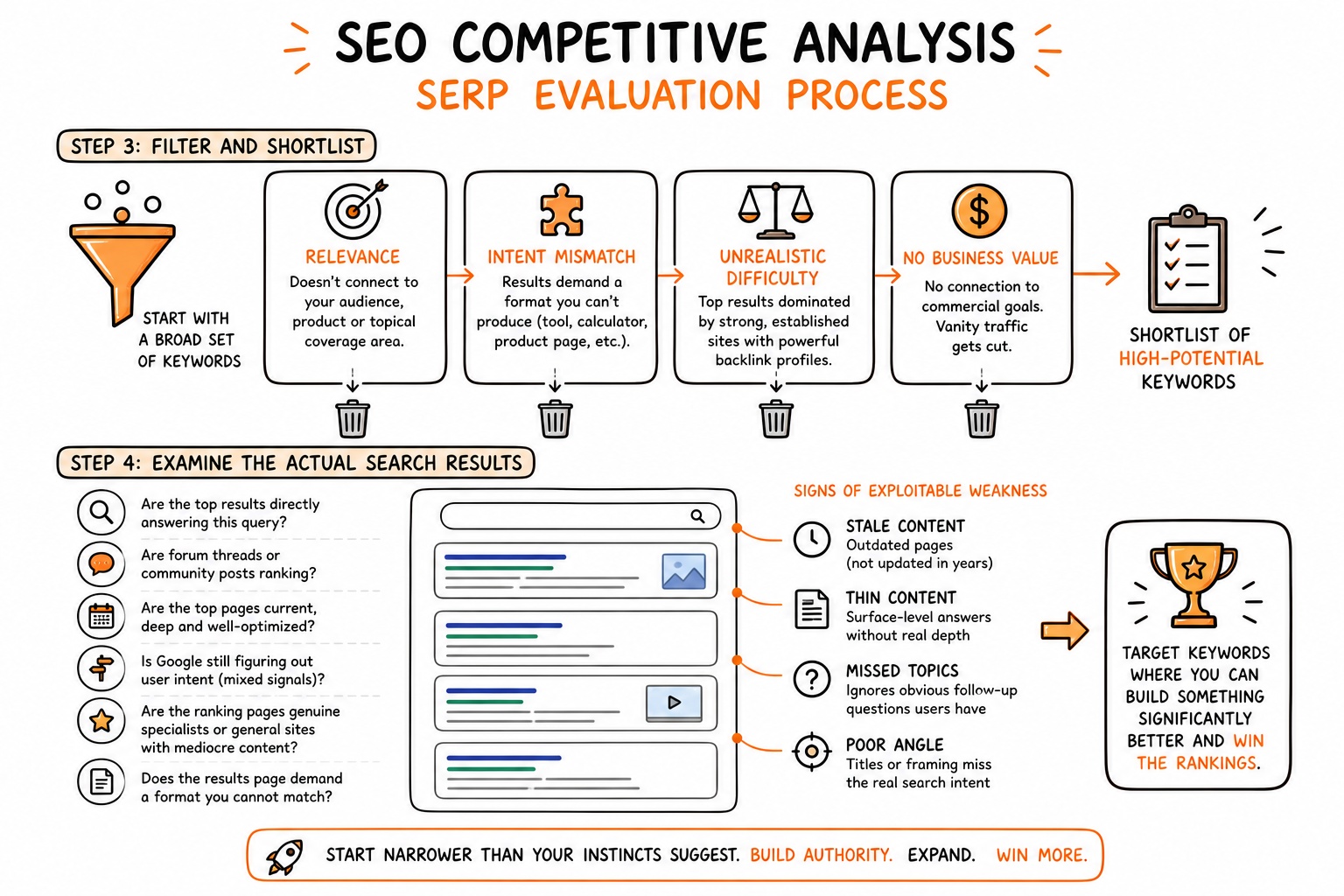
Step 3: Cut Obvious Losers Before Detailed Analysis
At this stage the goal is not to pick final targets. The goal is to eliminate the candidates that obviously will not work so you do not waste time on detailed analysis for keywords that were never viable.
Apply these filters quickly:
- Relevance: If the keyword does not connect to your audience, your product, or your topical coverage area, remove it without sentiment.
- Intent mismatch: If the current results clearly demand a content format you cannot produce — a free tool, an interactive calculator, a product listing page — set it aside for now.
- Unrealistic difficulty: Be honest about your current domain authority and cut keywords where the existing results are dominated by large, well-established sites with extensive backlink profiles.
- No business value: Traffic from keywords with no connection to your commercial goals is vanity traffic. Keep a healthy balance of informational and commercial intent, but do not fill your production queue with keywords that will never convert.
Most sites aim too broadly too early and then conclude that SEO does not work. Starting narrower than your instincts suggest and expanding as you build authority is consistently the faster path to real results.
Step 4: Examine the Actual Search Results
This is the step almost everyone skips. It is also the step that saves the most time and prevents the most wasted content investment.
Pull up the actual search results for every shortlisted keyword and evaluate what you are actually competing against:
- Are the top results directly answering this query, or are they only loosely connected to it?
- Are there forum threads or community posts ranking because Google cannot find a better specialist page?
- Are the top pages current, deep, and clearly well-optimized, or are they old, thin, and vague?
- Is Google still figuring out what users actually want for this query (mixed intent signal)?
- Are the ranking pages genuine specialists on this topic, or are they large general-authority sites with mediocre content?
- Does the results page demand a content format you cannot match?
Content format matters enormously. If the top results are free tools, you generally need to build a tool to compete. If they are step-by-step guides, build a guide. If they are comparison articles, build a comparison. Google has already done significant intent research for you by assembling the current results — read what those results are telling you.
A keyword becomes genuinely attractive when the search results are weak in a way you can exploit. The strongest signals of exploitable weakness are stale content that has not been updated in years, thin pages that address the surface question without depth, pages that ignore the obvious follow-up questions, and pages whose titles or framing miss the actual angle most users are searching from.
Step 5: Group Keywords by Shared Intent Before Writing
One strong page consistently outperforms several thin pages targeting isolated variations of the same query. Before you start writing, group your validated keywords by the underlying intent they share.
Keywords that describe the same situation from slightly different angles almost always belong in the same page. Your primary keyword becomes the main target. The related variations inform your headings, FAQ sections, examples, and internal anchor text.
Only separate keywords into different pages when the actual search results clearly separate them — when Google is ranking fundamentally different content formats or addressing clearly different user needs for each variation.
This clustering process is what separates teams that build genuine topical authority from teams that perpetually chase isolated keywords. A cluster of ten tightly related pages, each internally linked and each addressing a specific angle of a broad topic, accumulates authority and rankings far faster than ten isolated articles targeting random keywords.
Step 6: Build the Page That Deserves to Win
The content strategy question is not "how do I write a page that is optimized for this keyword?" The content strategy question is "what does a page that genuinely deserves the top position for this query look like?"
Those are different questions, and the difference in the answers is where most keyword strategies succeed or fail.
A page that deserves to rank addresses the primary question completely, anticipates and answers the natural follow-up questions, provides information that cannot easily be found elsewhere or is organized better than anywhere else, and is written for the person asking the question rather than for the algorithm evaluating it.
AI tools can accelerate the drafting and structural organization of content. They cannot replace the genuine expertise, specific data, real examples, and editorial judgment that elevate a page from adequate to authoritative. Use AI to draft faster. Use human review to make the result genuinely better than what currently ranks.
How to Score and Prioritize Your Keyword List
Once you have a validated list, you need a systematic way to prioritize it. Difficulty scores alone do not give you enough information. Here is a scoring framework that forces you to evaluate everything that matters.
Rate each keyword from 0 to 3 on seven dimensions:
| Factor | 0 | 1 | 2 | 3 |
|---|---|---|---|---|
| Relevance | Barely related | Loosely related | Strongly related | Directly tied to your offer |
| Business value | No value | Indirect | Some commercial value | Clear path to revenue |
| Demand signal | Weak or uncertain | Some evidence | Clear evidence | Strong, multiple sources |
| Click potential | Poor SERP layout | Mixed | Good | Strong, minimal zero-click features |
| Relative difficulty | Unrealistic | Hard | Reachable | Very reachable for your site |
| SERP weakness | Strong incumbents | Some gaps | Clear gaps | Obvious exploitable weakness |
| Cluster fit | Isolated | Weak cluster | Good cluster | Strong cluster with many supporting terms |
Score interpretation:
- 14 or above: Prioritize for immediate production
- 10 to 13: Worth producing with the right strategic angle
- Below 10: Needs a very specific reason to make the queue
This system is intentionally more demanding than a simple difficulty cutoff. It forces you to think simultaneously as a strategist, an editor, and the person who will actually be trying to rank the page. Applying it consistently moves your keyword decisions from gut feel to a repeatable, defensible prioritization process.
Keyword Modifier Banks by Business Type
When your seed ideas run dry, these modifier patterns generate new low-competition angles reliably.
For SaaS and software companies: Combine your product category with role modifiers (for startup founders, for enterprise procurement teams), industry modifiers (for law firms, for healthcare practices, for e-commerce brands), and transition modifiers (alternative to, migrate from, replace, vs). Most SaaS companies cover the broad generic terms reasonably well. The underserved territory is in the specific roles, industries, and migration scenarios they have not addressed.
For e-commerce businesses: Combine product categories with use-case modifiers (for trail running, for flat feet, for wide feet), material or specification modifiers (waterproof, dishwasher safe, BPA-free), and problem-solved modifiers (prevent blisters, reduce back pain, for sensitive skin). Comparison and compatibility queries are also consistently underserved in most e-commerce niches.
For local service businesses: Combine your service category with location modifiers (in Denver, near downtown, serving the Westside), urgency modifiers (same-day, emergency, 24-hour), and specificity modifiers (for commercial properties, for historic homes, for rental properties). These modifier combinations reliably shrink competition to a fraction of the generic category term.
For content publishers and media sites: Combine your topic area with year and recency modifiers (2026, updated, current), comparison modifiers (best, vs, compared to), and audience-stage modifiers (beginners, advanced, for professionals). Evergreen topics with outdated top results are often the strongest low-competition opportunities for content-focused sites.
Boost Your Keyword Research with FluxSerp
Finding low-competition keywords manually is possible — but doing it at scale, consistently, across dozens of topic clusters simultaneously, requires a systematic approach that goes beyond spreadsheets and manual SERP checks.
FluxSerp combines AI-powered keyword discovery, automated competitive analysis, and backlink tracking to surface the keyword opportunities your competitors have missed — and to monitor your rankings as you capture them.
- Identify untapped keyword opportunities before your competitors discover them
- Track ranking progress across every keyword cluster you are targeting
- Build authoritative backlinks systematically to strengthen your position in competitive SERPs
FluxSerp turns keyword insights into measurable organic growth and positions your brand for visibility in both traditional search results and AI-powered search platforms.
Common Mistakes That Quietly Kill Keyword Strategies
You can follow the right workflow and still undermine your results by falling into these traps. Each one appears repeatedly in failed keyword strategies.
Prioritizing volume before fit. Sorting by search volume first reliably leads to overvaluing keywords that look impressive in a spreadsheet but do not drive meaningful traffic or revenue. Volume is a starting indicator, not a strategic criterion.
Ignoring content format. If the search results are asking for a tool, a calculator, a template, or a product page, a blog post will lose regardless of how well optimized it is. Match the format the results are demanding before worrying about anything else.
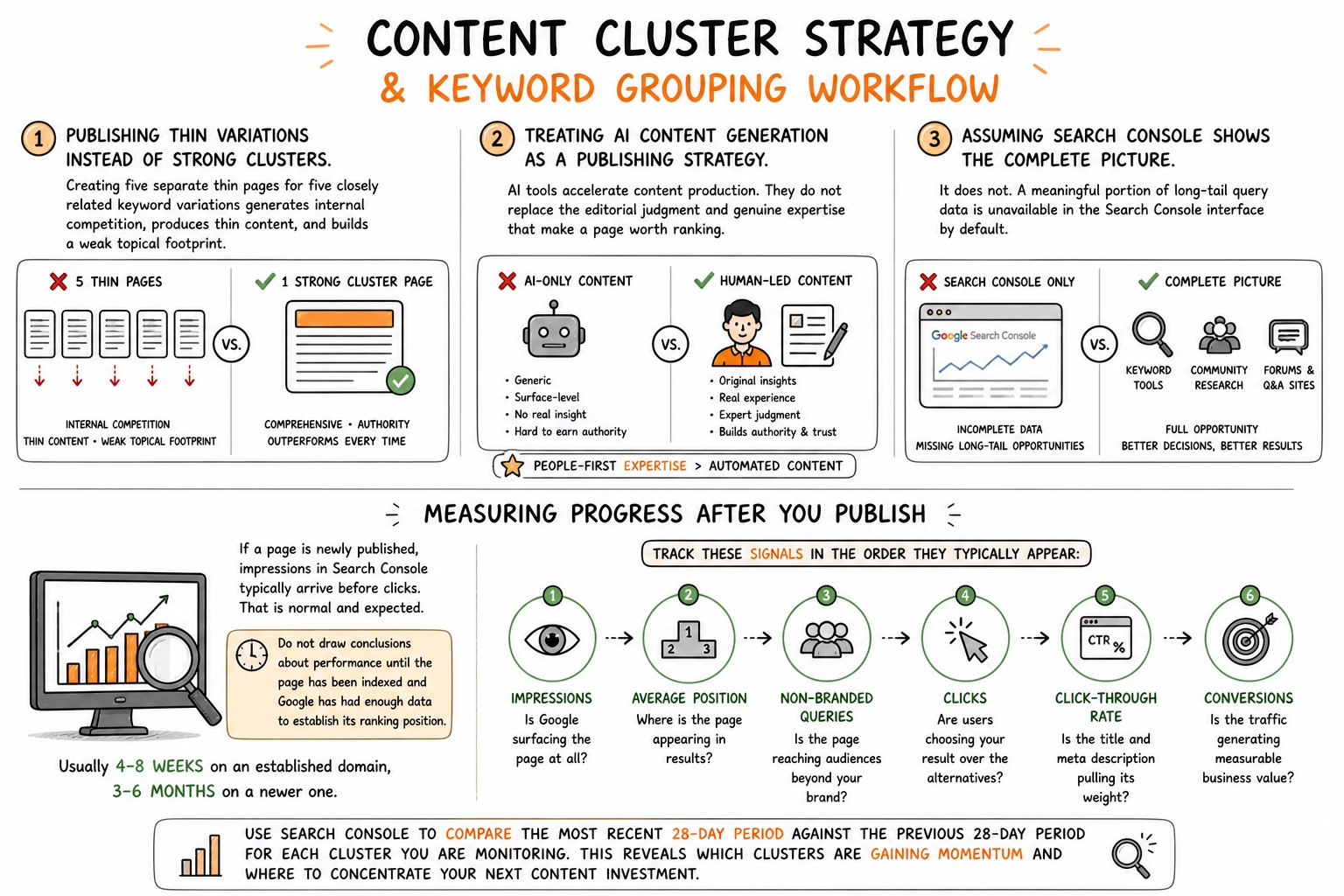
Publishing thin variations instead of strong clusters. Creating five separate thin pages for five closely related keyword variations generates internal competition, produces thin content, and builds a weak topical footprint. One comprehensive page targeting a cluster consistently outperforms five isolated thin pages.
Treating AI content generation as a publishing strategy. AI tools accelerate content production. They do not replace the editorial judgment and genuine expertise that make a page worth ranking. Pages that are clearly AI-generated without meaningful human contribution do not earn the authority that drives sustained rankings.
Assuming Search Console shows the complete picture. It does not. A meaningful portion of long-tail query data is unavailable in the Search Console interface by default. Supplement it with keyword tools and community research to access the full opportunity.
Measuring Progress After You Publish
If a page is newly published, impressions in Search Console typically arrive before clicks. That is normal and expected. Do not draw conclusions about performance until the page has been indexed and Google has had enough data to establish its ranking position — usually four to eight weeks on an established domain, three to six months on a newer one.
Track these signals in the order they typically appear:
- Impressions: Is Google surfacing the page at all?
- Average position: Where is the page appearing in results?
- Non-branded queries: Is the page reaching audiences beyond your existing brand awareness?
- Clicks: Are users choosing your result over the alternatives?
- Click-through rate: Is the title and meta description pulling its weight?
- Conversions: Is the traffic generating measurable business value?
Use Search Console to compare the most recent 28-day period against the previous 28-day period for each cluster you are monitoring. This comparison reveals which clusters are gaining momentum and where to concentrate your next content investment.
Key Takeaways
| Area | What to Do |
|---|---|
| Define low competition correctly | A keyword is low competition when the current results can be outranked by your site specifically, not when a tool assigns it a low score |
| Start with problems, not topics | Customer problems and specific situations produce better low-competition candidates than broad category terms |
| Use four research sources | Keyword tools, competitor gaps, Search Console, and community language each surface opportunities the others miss |
| Examine the actual results | SERP analysis is non-negotiable — it is the only way to evaluate whether the competition is genuinely beatable |
| Cluster before you write | Group related keywords by shared intent and build one strong page per cluster rather than thin pages per variation |
| Score systematically | Use a multi-factor scoring framework instead of relying on difficulty scores alone |
| Measure patiently | Rankings take time — evaluate performance over four-week comparison periods, not days |
The businesses that build sustainable organic traffic pipelines are not the ones that find the cleverest shortcuts. They are the ones that identify genuine demand gaps, produce content that actually fills those gaps better than the existing results, and repeat the process consistently enough for the compounding effect to take hold.
Start with one cluster. Publish one strong page. Let the data confirm the process works on your specific site. Then scale.

Catalin Dinca
Written by Catalin Dinca