

AI & Classic Search Visibility: What It Is and How to Master It in 2026 with Fluxserp
 Catalin Dinca
Most brands treat search visibility as a single thing. You rank on Google, you get traffic, you optimize, you rank higher. The loop is familiar and the tools for managing it have been refined over two decades.
That loop is no longer the whole picture. Search has split into two distinct channels that operate by different rules, reward different behaviors, and reach users at different moments. A brand that appears prominently in Google's results can be completely invisible in the AI-generated answers that now sit above, alongside, or entirely in place of traditional results. And a brand that earns consistent mentions in ChatGPT and Perplexity may or may not hold strong organic positions for the same queries.
Both types of visibility matter. The brands pulling ahead in 2026 are the ones that understand the difference between them, optimize for both, and track each with the precision it deserves.
What Classic Search Visibility Actually Measures
Classic search visibility — the kind that SEO has always been about — measures how prominently your brand's pages appear in organic search results across the queries that matter to your business. It is most commonly expressed as a share-of-voice metric: out of all the searches happening in your category, what percentage result in an impression of your page?
A brand with high classic search visibility shows up near the top of results for a wide range of relevant queries. A brand with low classic search visibility is buried on page two or beyond, capturing a fraction of the available traffic even when users are searching for exactly the kind of solution it offers.
The signals that drive classic search visibility are well established. Domain authority, earned backlinks, page-level relevance, technical health, Core Web Vitals, and user engagement signals all feed into where a page lands. The output is a ranked position, and the primary measure of success is how much of the available organic traffic your pages actually capture.
Classic search visibility is not going away. Billions of searches still happen on Google every day, and ranking well for the right queries still delivers meaningful, high-intent traffic. The problem is that for a growing category of informational and commercial queries, the click-through rate from traditional organic listings is declining. When an AI-generated answer appears at the top of a results page and fully addresses the user's question, a significant portion of users never scroll to the organic links below.
That is not a reason to abandon classic SEO. It is a reason to pair it with something else.
What AI Search Visibility Adds to the Picture
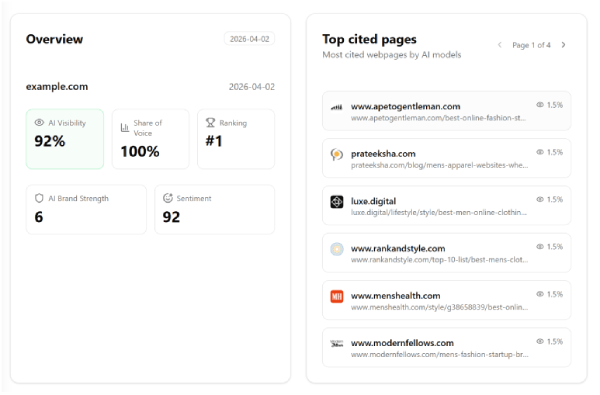
AI search visibility measures something fundamentally different. Instead of asking how often your pages appear in a list of ranked links, it asks how often your brand is mentioned, cited, or recommended in synthesized answers generated by AI platforms.
When a user asks ChatGPT to recommend a project management tool for a remote team, or asks Perplexity to compare the best email marketing platforms for small businesses, or uses Google AI Mode to research which accounting software integrates with Shopify, they are not reading a list of ranked links. They are reading a generated answer that names specific brands, makes direct comparisons, and often includes a recommendation. AI search visibility determines whether your brand is in that answer and how it is framed.
The measure is not position in a list. It is mention rate across relevant queries, sentiment around those mentions, competitive share of voice within AI answers, and the presence or absence of a source link back to your site. A brand can appear in 80% of AI answers for its target queries, or in none of them, and Google rankings will not tell you which is true.
This is why treating classic and AI visibility as separate disciplines with separate measurement systems is increasingly necessary, not optional.
Where Classic SEO and AI Visibility Overlap
The two channels share a meaningful foundation, which is good news for brands that have invested in quality SEO over time.
Domain authority transfers. AI systems use crawled web data to build their understanding of which brands and sources are trustworthy. A domain with strong authority signals — earned through consistent publication of credible content and a healthy backlink profile — is more likely to be treated as a reliable source by AI systems as well as by Google's ranking algorithm. The authority you have built for classic search is not wasted in the AI context.
Content quality is valued by both. Thin content, keyword-stuffed pages, and low-effort articles perform poorly in Google rankings and rarely get cited by AI systems either. Both channels reward content that is genuinely useful, clearly written, and directly responsive to real user questions. Investment in substantive content serves both channels simultaneously.
Technical accessibility matters in both contexts. Pages that are slow to load, difficult to crawl, or poorly structured are less likely to rank and less likely to be retrieved by AI systems using live browsing capabilities. Technical SEO improvements that make your pages more crawlable and faster to load benefit both channels.
External credibility is a shared signal. The same pattern of third-party mentions, independent reviews, and authoritative citations that helps build domain authority for classic search also shapes how AI systems perceive your brand's credibility. A brand discussed widely and credibly across the web performs better in both channels than one that exists primarily on its own domain.
Where the Two Channels Diverge
The overlap is real, but so are the gaps. Understanding where the two channels require different approaches is essential for building a strategy that performs in both.
Classic SEO is organized around keywords and ranked positions. The optimization process involves identifying which queries matter, building pages that are relevant to those queries, earning authority signals, and improving position over time. The output you are optimizing for is a link that a user chooses to click from a list of alternatives.
AI visibility is organized around entity recognition and narrative trust. AI systems do not return a list of links for the user to choose from. They generate a recommendation. Getting into that recommendation requires that the AI system has sufficient understanding of your brand to include it, that it has reason to trust your brand as a credible answer to the user's question, and that the framing of your brand in its training and retrieval data positions it positively relative to alternatives.
This means content strategy looks different for each channel. Classic SEO content is built around keyword clusters and optimized for search intent signals. AI visibility content is built around direct answers to the questions users are actually asking AI platforms, often structured as standalone explanatory sections that AI systems can extract and synthesize without needing to process the entire page.
Citation sources also differ. Building domain authority for classic SEO means earning links from relevant, authoritative sites. Improving AI visibility means earning coverage in the specific publications, review sites, and expert sources that AI systems draw on when generating answers in your category. Those two sets of sources overlap but are not identical, and understanding which publications AI systems are actually citing in your category is only possible if you are tracking AI responses directly.
Ranking volatility follows different patterns as well. Classic search rankings shift relatively slowly in response to algorithm updates and competitor movements. AI visibility can change within days when a model updates its training data or changes its retrieval weighting. A brand that monitors only classic rankings can miss significant shifts in its AI visibility that are happening on a much faster cycle.
How to Improve Classic Search Visibility
The fundamentals of classic search visibility have not changed in their essentials, even as the competitive environment has intensified.
Build Depth on Topics That Matter
Surface-level content on a wide range of topics rarely earns strong rankings in competitive categories. What earns consistent organic visibility is deep, comprehensive coverage of a focused topic area — the kind of coverage that signals genuine expertise to both search algorithms and the users who read it.
Identify the core topic area where your brand has real expertise and build that area out systematically. Cover the primary questions in depth, address related subtopics, connect pieces of content through internal linking, and revisit older content to keep it current and accurate. A cluster of interlinked, expert-level content on a focused topic consistently outperforms a scattered collection of thin articles across many different subjects.
Earn Links That Reflect Genuine Authority
Backlink quality matters more than quantity. A handful of links from highly authoritative, relevant publications in your industry moves the needle more than dozens of links from low-quality sources. The same mindset that drives effective digital PR — identifying the publications your audience actually reads and earning genuine coverage there — produces the links that matter most for classic search visibility.
The practical target is not a link count but editorial coverage in the sources that carry real authority in your space. Industry publications, analyst reports, independent review sites that your customers consult, and expert roundups are the kinds of sources that drive both domain authority and AI citation.
Keep Your Technical Foundation Clean
Technical SEO problems compound over time. A site with crawl errors, slow page speeds, duplicate content, or broken internal linking structure is leaving ranking potential on the table regardless of how good its content is.
A regular technical audit cadence — checking for crawl errors, monitoring Core Web Vitals, ensuring that your most important pages are indexed and canonicalized correctly, and fixing broken links as they appear — keeps your technical foundation from becoming a drag on your content efforts.
Target Queries Where You Can Compete
Not every query in your category is worth pursuing with equal intensity. Classic search visibility strategy is most effective when it prioritizes the queries where your content has a realistic path to ranking in the top positions and where those positions actually deliver meaningful traffic.
High-volume queries dominated by major publications or well-resourced competitors may take years and significant investment to crack. Lower-volume, higher-specificity queries where your expertise is directly relevant can deliver strong traffic much more quickly and often attract users who are further along in the research process.
How to Improve AI Search Visibility
AI visibility requires a set of practices that go beyond classic SEO, even when they build on the same foundation.
Structure Your Content Around Direct Answers
AI systems are looking for content that makes clear, confident claims. A page that buries its main point in caveats and qualifications is harder for an AI system to extract useful information from than one that leads with a direct answer and then elaborates.
For every topic your content covers, identify the core question and answer it at the start of the relevant section. Use specific, factual language rather than hedged or promotional copy. Write each section so that it communicates its key point even if the reader, or an AI system, encounters it in isolation from the rest of the page.
Map Your Content to the Prompts Users Actually Ask
The queries that drive AI visibility are often phrased differently from the keyword queries that drive classic search. Users tend to ask AI platforms in natural language, in full sentences, with context embedded in the question. The prompts that matter for AI visibility are things like "what is the best tool for managing client projects in a small agency" or "how does X compare to Y for e-commerce brands" rather than short keyword fragments.
Finding those prompts requires looking beyond keyword research tools. Customer support logs, sales call recordings, community forums, and the questions that come up in consultations with clients all surface the natural-language questions that your target audience is asking. Those are the prompts to build content around for AI visibility.
Make Your Brand's Entity Clear Across the Web
AI systems build their understanding of your brand from everything they can find about it — not just your own site, but every credible third-party mention, review, forum discussion, and publication that references what you do. When that picture is consistent and specific, AI systems can represent your brand accurately. When it is fragmented or contradictory, AI systems either misrepresent your brand or omit it from answers where it belongs.
Consistency in how your brand is described across your own properties is the starting point. Your homepage, about page, product descriptions, and social profiles should all convey the same core positioning. Beyond that, actively pursuing coverage in sources that accurately describe what your product does and who it serves builds the external picture that AI systems draw on.
Track Which Sources AI Platforms Are Citing in Your Category
This is the step that most brands skip, because it is not possible without dedicated AI tracking. The publications and platforms that AI systems rely on when generating answers in your category are not always the same ones that rank well organically or that your PR team typically targets.
Knowing which sources are being cited when AI platforms discuss your category gives you a directly actionable list of coverage targets. If a particular review publication or industry media outlet consistently appears as a source in AI answers related to your product area, earning coverage there is a direct path to improving AI visibility. Without tracking actual AI responses, that information is not available.
TRACK YOUR BRAND AND CREATE CONTENT ON AUTOPILOT
with the FluxSERP AI Visibility Toolkit
Sign Up NowHow FluxSERP Tracks Both Types of Visibility in One Place
Managing classic search visibility and AI visibility as separate disciplines, with separate tools and separate reporting cycles, creates a fragmented picture of how your brand is actually performing in search. FluxSERP is built to give you both views in a single dashboard so that the relationship between the two is always visible.
Classic Search Tracking
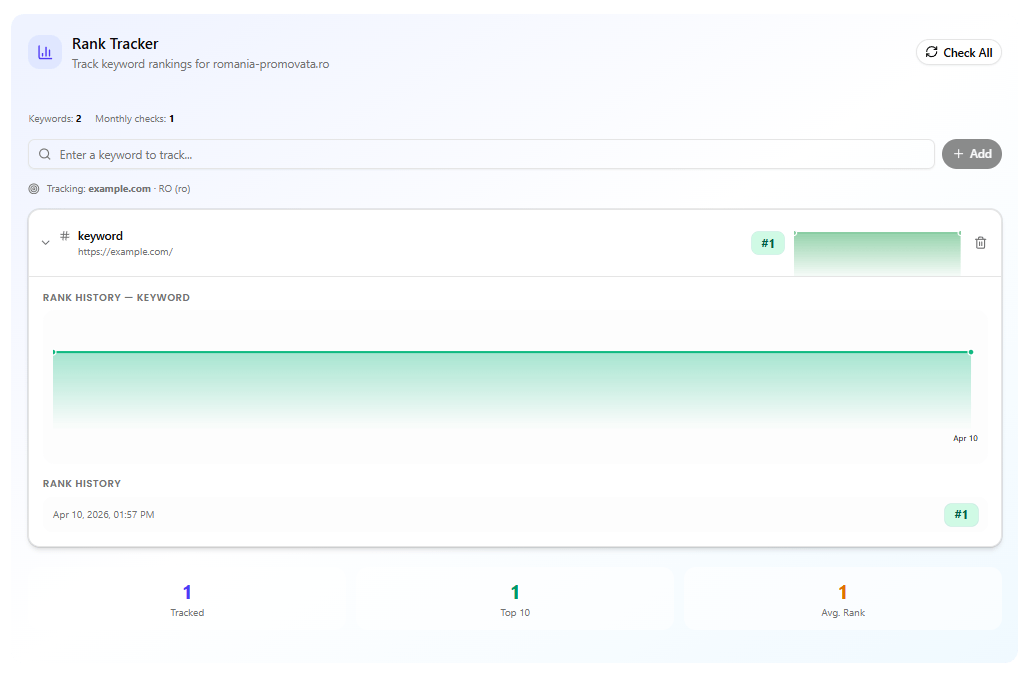
FluxSERP monitors your keyword rankings across search engines on a continuous basis, tracking position changes, identifying which queries are gaining or losing visibility, and benchmarking your performance against competitors. The share-of-voice view shows you how your overall search presence compares to the competitive field rather than reporting rankings in isolation.
The platform surfaces the technical and content signals that correlate with ranking changes, so you are not just watching positions move but understanding what is driving the movement. When a competitor gains ground on a set of queries, FluxSERP shows you what changed in their content or backlink profile so you can respond with informed decisions rather than guesswork.
AI Visibility Tracking
FluxSERP runs your target prompts across the major AI platforms — ChatGPT, Perplexity, Gemini, Google AI Mode, and others — on a regular schedule and records whether your brand appears, where it appears relative to competitors, what sentiment surrounds the mention, and whether a source link is included.
The Source Attribution feature identifies which external sites are being cited when AI platforms generate answers in your category, giving you a direct view of the coverage targets that will move your AI visibility most efficiently. The Competitor Intelligence dashboard shows which queries and platforms your competitors are winning in AI answers that your brand is missing from, making it straightforward to prioritize where to focus.
Seeing the Full Picture Together
The most valuable insight FluxSERP provides is the relationship between the two channels. Some queries where you rank well organically are queries where your AI visibility is strong. Others are queries where your organic ranking is solid but your brand never appears in AI answers — a signal that the content, while well-optimized for classic search, is not structured or cited in a way that earns AI citation.
Identifying those gaps is only possible when both types of visibility are tracked together and compared directly. Closing those gaps is the work that separates brands with a comprehensive search presence from those that are strong in one channel and invisible in the other.
The Practical Starting Point
The easiest way to understand where your brand stands across both types of search visibility is to start measuring. Tracking what is actually happening — which queries drive your organic visibility, where your brand appears and does not appear in AI answers, how competitors are positioned in both channels — gives you a factual foundation for decisions rather than assumptions.
FluxSERP's dashboard is built to make that measurement accessible from day one, without requiring a complex technical setup or separate tools for each channel. You set up your brand, your competitors, and the queries that matter to your business. The platform handles the tracking and surfaces the insights that tell you where to act.
Start with FluxSERP today and get a complete picture of your brand's visibility across the two search channels that matter most in 2026.
AI and Classic Search Visibility FAQs
What is the difference between classic search visibility and AI search visibility?
Classic search visibility measures how prominently your brand's pages appear in traditional organic search results — the ranked links returned by Google and other search engines. AI search visibility measures how often your brand is mentioned, cited, or recommended in AI-generated answers from platforms like ChatGPT, Perplexity, and Gemini. Both matter, but they are driven by different factors and require different tracking approaches.
Do classic SEO rankings affect AI visibility?
They influence it but do not determine it. A strong domain authority and high-quality content improve the likelihood of appearing in AI-generated answers, but ranking well on Google does not guarantee AI citation. Research has found that fewer than half of Google's top-ranking pages for any given query appear in AI answers for the same topic. Strong SEO is a useful foundation for AI visibility, but the two channels require distinct optimization work.
Can a brand appear in AI answers without ranking well organically?
Yes. AI systems draw from their training data and live retrieval mechanisms, which are not limited to pages that rank highly in Google. A brand with strong third-party coverage in credible independent sources can earn consistent AI citation even in categories where its organic rankings are not top-tier. This is one of the reasons AI visibility is worth tracking separately from classic rankings.
How often do AI visibility results change?
More frequently than classic search rankings. AI responses can shift within days of a model update, a change in retrieval weighting, or new content being indexed and incorporated into the sources AI systems draw from. Monthly monitoring is insufficient for AI visibility; a weekly tracking cadence is the practical minimum for most brands, and FluxSERP automates that cadence so it does not require manual effort each cycle.
Which AI platforms should I track for AI visibility?
The right platforms depend on where your target audience is active. ChatGPT, Perplexity, and Gemini currently account for the largest share of AI search traffic across most industries, and Google AI Mode is increasingly significant for queries that used to go to traditional Google search. FluxSERP tracks all of these and surfaces the platform-level breakdown so you can see where your visibility is strong and where it needs work.
What is the fastest way to improve AI visibility if I already have strong organic rankings?
The fastest lever is usually targeted digital PR aimed at the specific publications and sources that AI systems cite most often in your category. FluxSERP's Source Attribution feature shows you exactly which external sites are driving AI citation in your category, so you can direct PR efforts toward the sources that will have the most direct impact rather than guessing.
How does FluxSERP help with both types of search visibility?
FluxSERP tracks classic keyword rankings and AI visibility from a single dashboard. On the classic side, it monitors your positions, tracks competitor movements, and measures share of voice across your target queries. On the AI side, it runs your prompts across major AI platforms, records mention rate and sentiment, identifies which external sources AI systems are citing in your category, and benchmarks your AI visibility against competitors. Having both data sets in one place makes it possible to see the relationship between the two channels and identify where gaps exist.

Catalin Dinca
Written by Catalin Dinca