

AI Visibility: What It Is and How to Get Your Brand Featured in 2026
 Catalin Dinca
There is a gap opening up between brands that appear in traditional search results and brands that appear in AI-generated answers. The two do not always overlap. In fact, research comparing Google's top ten organic results against pages cited by major AI platforms found that fewer than half of top-ranking pages ever appeared in an AI answer at all.
That gap is where AI visibility lives. And in 2026, it is one of the most consequential gaps in digital marketing.
What Is AI Visibility?
AI visibility is the measure of how often your brand is mentioned, cited, or recommended in responses generated by AI platforms such as ChatGPT, Perplexity, Google AI Mode, and Gemini. When a user asks one of those platforms to recommend a tool, compare solutions, or explain a concept relevant to your industry, AI visibility determines whether your brand makes it into that answer and how prominently.
It is not a single number. It is a combination of factors: how often your brand appears across relevant queries, how it is positioned relative to competitors, whether those appearances include a link to your site, and whether the surrounding context describes your brand accurately and positively.
A brand with strong AI visibility gets recommended. A brand with weak AI visibility is invisible to a large and fast-growing segment of potential customers, regardless of how well it ranks on Google.
Why AI Visibility Matters in 2026
The practical reason AI visibility matters is that the audience using AI platforms to research purchases and evaluate options is growing fast and converting well.
Users who arrive from AI platforms tend to have already done significant research before they click through. They have asked questions, compared options, and narrowed their consideration set, often entirely within the AI interface. By the time they visit your site, they are much closer to a decision than the average organic search visitor.
This changes the value calculation. A brand that appears consistently in AI-generated answers is not just gaining impressions. It is inserting itself into the consideration set of users who are close to converting. That is a meaningfully different kind of visibility than a ranked link on a results page that a user might or might not click.
At the same time, AI platforms are becoming the first stop for many informational queries that used to go to search engines. Someone trying to understand the difference between two software tools, or looking for a recommendation on which project management platform fits a specific team size, is increasingly likely to ask ChatGPT or Perplexity rather than Google. If your brand is not present in those answers, it is simply not part of that conversation.
How AI Visibility Differs from Traditional SEO
Traditional SEO is built around the goal of ranking higher in search engine results pages. The primary output is a ranked link. The primary metric is position. The mechanism is well understood: relevance, authority, technical quality, and user experience signals combine to determine where a page lands.
AI visibility optimization shares some of those inputs — domain authority, content quality, and relevance all matter — but the output is different. AI systems do not return a ranked list. They generate a synthesized answer that draws from multiple sources, names specific brands, and makes recommendations. Getting into that answer requires more than ranking well on a keyword. It requires being the kind of source that AI systems trust enough to cite.
The key differences come down to a few practical points.
AI systems select sources based on how clearly and confidently a piece of content makes a claim, not just on how well a page ranks for a related keyword. Content that hedges, qualifies, and avoids direct answers is harder for AI systems to extract useful information from, and so it gets cited less often.
AI systems are heavily influenced by how a brand is discussed across the broader web, not just on its own properties. Third-party coverage in credible publications, independent reviews, mentions in industry forums, and citations from authoritative domains all shape the picture an AI system has of your brand. A brand that exists only on its own website is at a significant disadvantage.
AI citation patterns also vary considerably across platforms. Content that gets cited frequently in Perplexity may look different from what gets cited in ChatGPT, because each platform has different training data, different retrieval mechanisms, and different tendencies for how it structures responses. A serious AI visibility strategy accounts for those differences rather than treating all platforms as identical.
How to Measure Your AI Visibility
Measuring AI visibility starts with choosing the right prompts, knowing what to look for in the responses, and building a consistent tracking system that lets you see changes over time.
Choose Your Platforms and Prompts
Begin by identifying which AI platforms your target audience actually uses. If you have referral traffic data, check whether any of it is coming from AI platforms already — that is a direct signal of where your audience is active. If you can speak to customers directly, ask them which tools they use to research purchases in your category.
Once you know which platforms to focus on, build a prompt list that covers the full range of questions your audience asks at each stage of research. This should include broad category queries like "best tools for X," specific use-case queries like "which platform is best for small teams that need Y," comparison queries like "X versus Y," and evaluation queries like "is X worth it" or "X alternatives."
Track Mentions, Sentiment, and Position
For each prompt across each platform, you are looking for four things: whether your brand appears at all, where it appears relative to competitors, what language surrounds the mention, and whether a link to your site is included.
Doing this manually is feasible for a small prompt set across one or two platforms, but it does not scale. Manual checks also miss the variation that happens between sessions — AI responses are not always identical for the same prompt, so a single manual check can give a misleading picture of how consistently your brand appears.
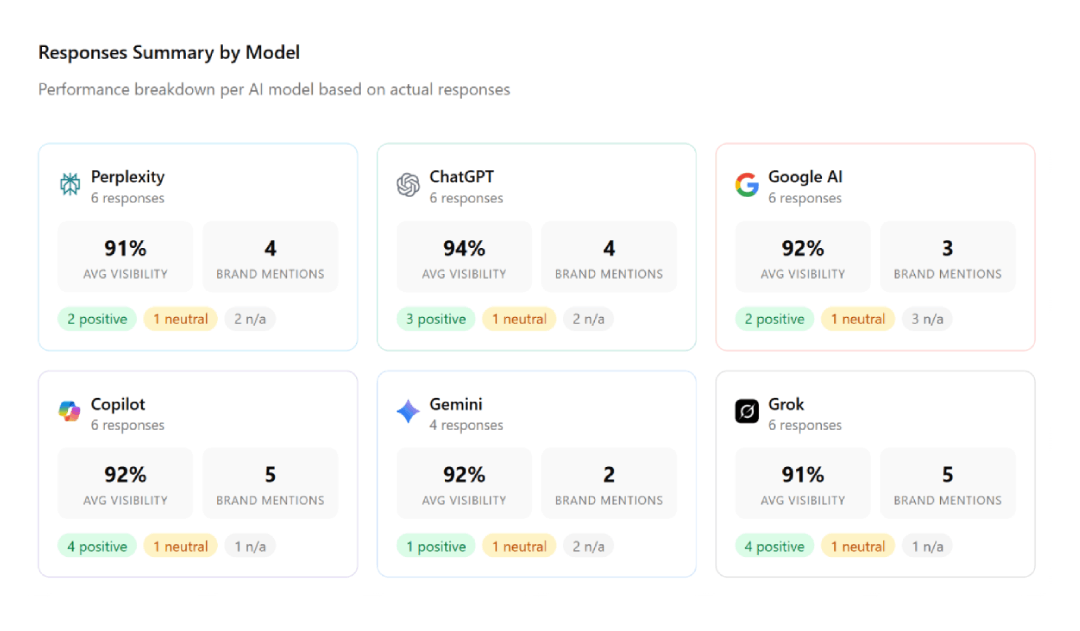
Tools like FluxSERP automate this process, running your prompt list across platforms on a regular schedule and recording mention rate, sentiment classification, and competitive position for each response. That gives you a reliable baseline and the ability to track changes over time rather than relying on point-in-time snapshots.
Benchmark Against Competitors
Your raw mention rate only becomes meaningful when you compare it to how often competitors appear in the same responses. If your brand appears in 40% of relevant AI answers but your closest competitor appears in 80%, you have a clear gap to close. If you appear in 40% and your competitors average 20%, you are already ahead and the priority is maintaining and extending that lead.
Competitor benchmarking also reveals which platforms represent your biggest opportunity. A brand may lead on Perplexity but trail significantly on ChatGPT, which suggests the content and external signal strategy needs platform-specific adjustment.
How to Grow Your AI Visibility
Create Content That Directly Answers the Questions Users Ask
The most direct path to AI visibility is content that answers the specific questions users ask AI platforms in your category. Not content optimized around keyword volume, but content built around the actual queries that land in ChatGPT and Perplexity.
Finding those queries takes some work. Start with your own customer data: what do support tickets ask about, what comes up repeatedly in sales calls, what questions show up in community forums related to your industry? The People Also Ask sections in Google search results are also a useful proxy — those questions are often very similar to what users ask AI platforms.
Once you have a list of real questions, create content that answers each of them directly and clearly. The answer should come at the start of the section, before the elaboration. The language should be specific and factual, not hedged or qualified into vagueness. Each section should make sense on its own, because AI systems often extract individual sections rather than processing a full page.
Build External Authority Through Coverage and Citations
One of the strongest signals AI systems use when deciding whether to cite a brand is how broadly and credibly that brand is discussed across the web. A brand mentioned consistently in reputable independent sources — review publications, industry media, analyst reports, credible forums — is much more likely to appear in AI-generated answers than a brand that exists only on its own site.
This makes earned media and digital PR directly relevant to AI visibility, not just to backlink profiles. A feature in an industry publication, a detailed independent review, expert mentions in roundup articles — all of these contribute to the breadth of external signal that AI systems use to assess a brand's credibility and relevance.
The practical target is not quantity of mentions but quality and specificity. A detailed review that accurately describes what your product does, who it is for, and how it compares to alternatives is worth far more for AI visibility than a passing name mention in a generic listicle.
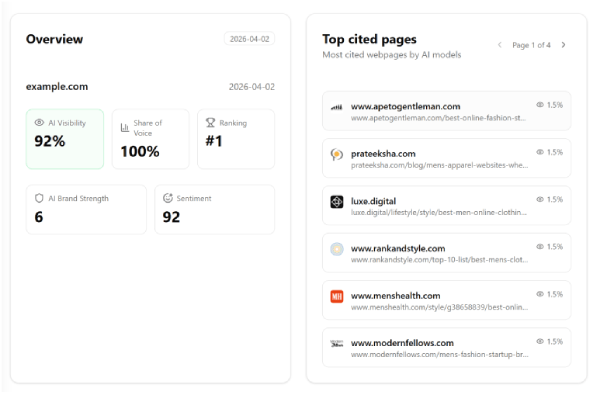
Tracking which external sites AI platforms cite most often in your category is one of the most actionable things you can do. If you can identify the publications and platforms that consistently appear in AI answers for your target queries, those become your highest-priority targets for earned coverage.
Keep Your Content Fresh
AI platforms show a clear preference for recently published and recently updated content. This applies both to how AI systems weight content in their training data and to what they retrieve through live browsing tools. A page that was excellent when published two years ago but has not been touched since is at a disadvantage compared to a more recently updated competitor.
Building a regular content maintenance cadence into your workflow — refreshing statistics, expanding sections that address new questions, adding context about recent developments — keeps your existing content competitive without requiring you to create new pages for every topic.
Align Your Brand Messaging Across All Properties
AI systems build their understanding of a brand by drawing from everything they can find about it: your own site, third-party coverage, social profiles, reviews, forum mentions, and more. When that information is consistent, the picture is clear. When it is inconsistent — different descriptions of what you do, different positioning across channels, conflicting information about who your product is for — the AI's understanding becomes fragmented and less reliable.
An audit of your homepage, about page, product pages, social profiles, and any major directory listings to ensure they all describe your brand in consistent terms is a practical step that improves both AI visibility and general brand clarity.
Use Structured Markup to Make Your Content Easier to Extract
Schema markup gives AI crawlers explicit signals about what a page contains. FAQ schema, Article schema, Product schema, and Organization schema all help AI systems categorize your content correctly and extract specific claims with confidence. If you are not using structured data, implementing it is a relatively low-effort change that improves both AI visibility and traditional SEO simultaneously.
Tracking AI Visibility Over Time with FluxSERP
AI visibility is not static. Models update, training data refreshes, and the sources AI platforms prefer shift. A brand's AI visibility can improve significantly within a few months of consistent effort — or decline if competitors invest in the space while you do not.
That is why ongoing tracking matters as much as initial measurement. FluxSERP's AI visibility dashboard shows you how your mention rate, sentiment, and competitive positioning change over time, which specific queries are driving improvements, and where gaps remain. The Source Attribution feature reveals which external sites are being cited when AI platforms discuss your category — so you can see exactly which publications and platforms you need to earn coverage in to close the gap with competitors.
Start tracking your AI visibility with FluxSERP today to get a clear picture of where your brand stands across ChatGPT, Perplexity, and Gemini — and the data you need to grow it.
AI Visibility FAQs
What is AI visibility?
AI visibility is how often your brand is mentioned, cited, or recommended in AI-generated responses across platforms like ChatGPT, Perplexity, Google AI Mode, and Gemini. It measures your presence in AI search independently of your traditional Google rankings.
Why should I track AI brand visibility?
You should track AI brand visibility because a growing share of purchase research now happens inside AI platforms rather than on search engine results pages. If your brand is absent from AI-generated answers in your category, you are invisible to a segment of potential customers who are actively researching and close to making a decision.
Does ranking well on Google guarantee AI visibility?
No. Research comparing Google's top ten organic results against AI-cited pages found that fewer than half of top-ranking pages ever appeared in an AI answer. Strong SEO is a useful foundation for AI visibility, but it does not automatically translate into AI citation. The two require overlapping but distinct optimization work.
How often should I check my AI visibility?
A weekly tracking cadence is practical for most brands. AI responses can shift meaningfully within days of a model update, new content being indexed, or a competitor's coverage expanding, so monthly checks may miss important changes. Automated tools like FluxSERP make weekly tracking straightforward without requiring manual effort each time.
What is the fastest way to improve AI visibility?
The fastest lever is typically targeted digital PR aimed at the specific publications and platforms AI systems cite most frequently in your category. If you can identify which sources are driving competitor appearances in AI answers and secure coverage in those same sources, you directly address the external signal gap. FluxSERP's Source Attribution feature is designed specifically to surface those targets.
How can I identify gaps in my brand's AI search visibility?
The most practical approach is to compare where competitors appear in AI answers across your key queries and identify prompts where they show up consistently but you do not. FluxSERP's Competitor Intelligence dashboard does this automatically, showing you which queries and platforms are driving competitor visibility that your brand is missing.
Can small brands compete for AI visibility against large established competitors?
Yes, and often more effectively than in traditional search. AI systems favor specificity and clarity over domain size. A smaller brand with deeply authoritative content on a specific topic, consistent external coverage in credible niche sources, and clear entity definition can outperform larger but less focused competitors on the queries that matter most. The key is targeting the right prompts rather than trying to compete broadly across every query in a category.

Catalin Dinca
Written by Catalin Dinca