

E-commerce Keyword Research in 2026: The Intent-First Method That Actually Drives Sales
 Catalin Dinca
Most e-commerce teams have a keyword problem they cannot see clearly. They have lists. They have rankings. They have traffic. What they do not have is clarity on whether the people arriving on their pages actually want to buy anything. That gap between traffic and buying intent is where organic revenue disappears.
The solution is not more keywords. It is a different way of choosing them.
This guide covers the intent-first approach to e-commerce keyword research: how to build a strategy around what buyers search at the moment they are ready to purchase, how to use AI tools to do it at scale without losing accuracy, and how to keep the system running so your keyword strategy stays current long after you finish building it.
Why Intent Beats Volume Every Time in E-commerce
Traditional keyword research for e-commerce often starts with a volume-sorted list. The assumption is that more searches means more opportunity. For an e-commerce store, that assumption breaks down quickly.
A term searched 10,000 times a month by people who are researching a topic is worth less than a term searched 500 times a month by people who have their credit card ready. This is not a theoretical point. It is a conversion rate reality that shows up in your analytics every single day. The phrase "buy men's running shoes size 11" describes a person who has made a decision. The phrase "types of running shoes" describes a person at the very beginning of a journey. Both are related to the same product category, but they belong on completely different pages with completely different content.
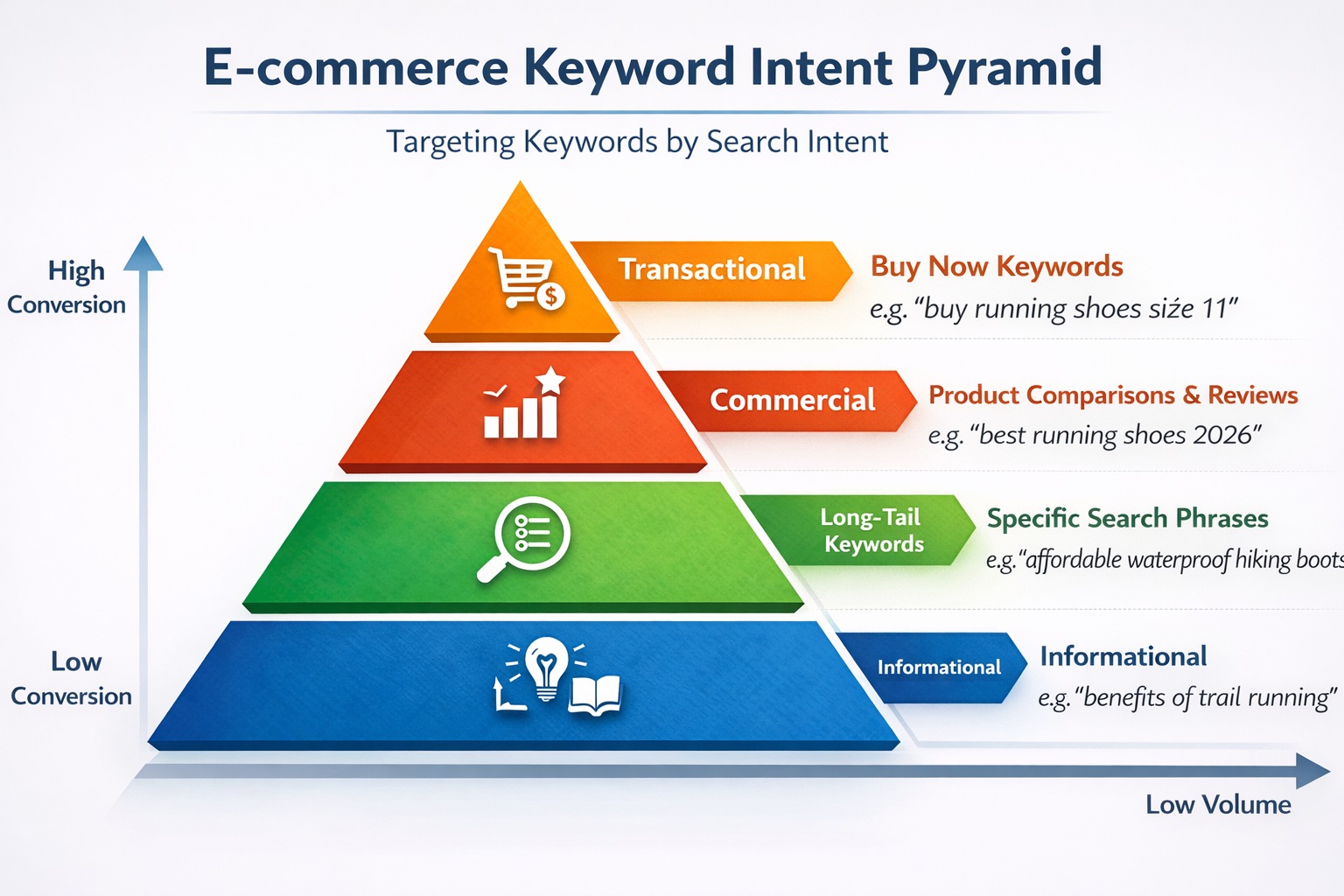
Intent-first keyword research means identifying, organizing, and prioritizing keywords based on where the searcher sits in the purchase decision, not how often they search the phrase. In e-commerce, that means concentrating your SEO energy on transactional and commercial intent keywords first, and building informational content as a supporting layer rather than the core.
The terms worth prioritizing break down into four types. Category keywords cover broad product lines and carry high volume with high competition. They are useful for brand awareness but rarely the direct source of conversions. Product keywords tied to specific models or SKUs carry lower volume but very high conversion potential because the searcher already knows what they want. Long-tail keywords are detailed, specific phrases that describe a precise need and tend to have lower competition alongside higher conversion rates. Comparison and review keywords capture buyers in the final stage of decision-making and work exceptionally well on category and blog pages.
Building Your Keyword List the Right Way
With intent as the organizing principle, the actual process of building a keyword list becomes much more focused. You are not trying to capture every possible search term. You are trying to map the specific phrases your buyers use when they are close to a decision.
Start with seed word expansion. Choose three to five core terms that describe your main product categories and expand each one into dozens of related phrases, variations, and question formats using keyword tools. This gives you the raw material you will refine later.
Run a competitor gap analysis next. Identify the top three competitors in your category and pull the keywords they rank for that you do not. These represent existing demand you are not currently capturing. When a competitor ranks for a transactional phrase and you do not, that is revenue passing you by every single day without you noticing it.
Question mining deserves more attention than most e-commerce teams give it. Pulling questions from forums, Reddit threads, and community platforms in your niche surfaces long-tail phrases with strong commercial or informational intent that standard keyword tools will not always find. These question-format keywords also perform well in AI-generated search summaries and featured snippets, which is increasingly important in 2026 as AI Overviews reshape how search results look for shoppers.
AI-powered clustering is where the process becomes scalable. Instead of manually sorting hundreds of keywords by intent, AI tools group them automatically by topic and intent type. What used to take a full day of spreadsheet work now takes minutes. The clustering is also often more accurate because it evaluates semantic relationships rather than surface-level word matching.
| Cluster type | Example keywords | Target page | Conversion potential |
|---|---|---|---|
| Transactional | "buy leather wallet men," "slim wallet free shipping" | Product / category page | Very high |
| Commercial | "best leather wallets 2026," "top wallets for men" | Blog / comparison page | High |
| Informational | "how to care for leather wallet" | Blog / guide page | Medium |
| Long-tail transactional | "slim RFID wallet under $40" | Product page | Very high |
How to Prioritize: Quick Wins vs Long-term Targets
Once you have a clustered keyword list, the next decision is where to focus first. Not all clusters deserve equal attention immediately. The teams that see the fastest results are the ones who separate quick-win opportunities from longer-term targets before they start creating or updating content.
Quick-win clusters share three characteristics: moderate search volume in the range of 500 to 5,000 monthly searches, low to medium keyword difficulty, and existing content on your site that already ranks somewhere between positions 11 and 30. These are pages that are almost ranking. A targeted optimization pass can move them onto page one without building anything new. This category tends to produce the fastest measurable return because you are amplifying something that already exists rather than starting from scratch.
Longer-term targets are high-competition, higher-volume keywords that require either new content or significant authority building to compete for. These are worth investing in, but they should not consume your first month of execution when quick wins are available and easier to measure.
Before committing a cluster to your content calendar, run it through five questions. Does this keyword have genuine buying intent or is it mostly informational? Can you realistically reach the top ten given your current domain authority? Is there an existing page you can update or does this require new content entirely? How seasonal is demand across the year? Does ranking for this keyword align with your highest-margin product lines?
Tracking Performance: The Metrics That Actually Matter
Publishing optimized content is step one. Knowing whether it is working is where most e-commerce SEO programs actually break down. Teams track rankings but not revenue. They track organic traffic volume but not the quality of that traffic.
Rankings tell you whether your optimization is gaining traction. Organic traffic tells you whether the improved ranking is translating to more visitors. Conversions per keyword is the metric that closes the loop between SEO effort and business outcome. This means tracking the number of orders, add-to-carts, or revenue attributed to shoppers who arrived via a specific search term. It is more work to configure than standard keyword tracking, but it is the only way to know definitively which keywords are actually paying for themselves.

The Quarterly Update Cycle You Cannot Skip
The most reliable way to watch an e-commerce SEO program stagnate is to treat keyword research as a one-time project. Consumer language shifts. New products enter your category. Competitors adjust their strategies. AI assistants change how buyers phrase their searches. The keyword landscape from six months ago is not the keyword landscape of today.
A quarterly keyword refresh addresses this by systematically reviewing what is working, what has fallen off, and what new opportunities have emerged. Pull your current rankings and identify which pages have dropped. Check Search Console for queries your pages are appearing for but not ranking well on, since these are emerging opportunities your current content is not fully capturing. Audit your top pages for freshness by reviewing whether the title, description, and on-page copy still match current search intent. Add new keywords that have surfaced from trend shifts, product launches, or new competitor behavior. Deprioritize terms that have lost conversion value.
This cycle is not a suggestion. It is the minimum maintenance standard for a keyword strategy that stays competitive in an environment where search behavior is changing faster than at any previous point.
How AI Search Changes the Keyword Equation in 2026
Something most e-commerce keyword guides written before 2025 do not address is the growing role of AI assistants in product discovery. When a shopper asks ChatGPT or Perplexity "what are the best waterproof hiking boots for wide feet," they are conducting a purchasing query through a channel that has nothing to do with a traditional search engine.
The phrases buyers use in AI assistant queries tend to be more conversational and more specific than traditional search strings. They sound more like questions you would ask a knowledgeable friend. This shifts the value of long-tail, question-format keywords significantly upward, because these are the phrase structures most likely to match the natural language queries that AI assistants process and respond to.
It also increases the importance of appearing in the sources that AI systems cite. Sites that are cited in AI-generated product recommendations tend to have structured content, strong topical authority in their category, and explicit answers to specific buyer questions. These are all things that intent-first keyword research naturally produces when done correctly.
Frequently Asked Questions
How often should I update my e-commerce keyword list?
At minimum, quarterly. Consumer language evolves, new products enter your category, and AI assistants are shifting how buyers phrase purchasing queries faster than most SEO teams update their keyword lists. A strategy built on six-month-old research is optimizing for how people searched in the past, not how they search right now.
What is the difference between transactional and commercial intent keywords?
Transactional intent keywords signal that the searcher is ready to buy. These include phrases like "buy," "order," "free shipping," or specific model names paired with purchase-adjacent language. Commercial intent keywords signal that the searcher is comparing options before deciding. These include phrases like "best," "top," "review," or "vs." Both belong in an e-commerce keyword strategy, but they target different pages and different stages of the buying journey.
Why do long-tail keywords convert better even though they have lower volume?
Lower volume usually means more specific intent. A shopper searching "slim RFID leather wallet for men under $50" has already made most of their purchase decisions. They know what they want, what features matter, and roughly what they want to pay. All they need is a product that matches. Long-tail keywords filter out casual browsers and bring in buyers.
How do I find keyword gaps compared to my competitors?
Run a competitor gap analysis using a keyword tool that supports position comparison. Enter your top three to five competitors and filter for keywords they rank for in the top ten that your site does not appear for at all. Sort the results by commercial and transactional intent first. These represent existing demand you are not currently capturing.
How does AI-powered keyword clustering work?
AI clustering analyzes the semantic relationships between keywords, not just shared words but shared meaning and shared intent. It groups keywords that a searcher with the same goal might use, regardless of whether those keywords share any identical words. This produces clusters that map naturally to content topics and buyer journey stages, making the jump from keyword research to content planning much more direct.
What metrics should I track to know if my keyword strategy is working?
Track three things. First, keyword rankings over time to see if optimization is gaining traction. Second, organic traffic to those pages to see if better rankings translate to more visitors. Third, conversion rate or revenue per keyword to see whether the traffic is actually buying. Volume and rankings without conversion data tell you how visible you are, not how effective your strategy is.
The e-commerce stores that consistently grow organic revenue are not the ones with the longest keyword lists. They are the ones that revisit their intent targeting every quarter, double down on what is converting, and treat keyword research as a system rather than a task.
Find the Keywords That Actually Drive E-commerce Sales
FluxSERP surfaces high-intent keyword opportunities, tracks your rankings in AI search, and shows you exactly where your competitors are gaining ground.
Start for Free
Catalin Dinca
Written by Catalin Dinca