

How Google's Ranking Systems Actually Work: A Practical Guide for 2026
 Catalin Dinca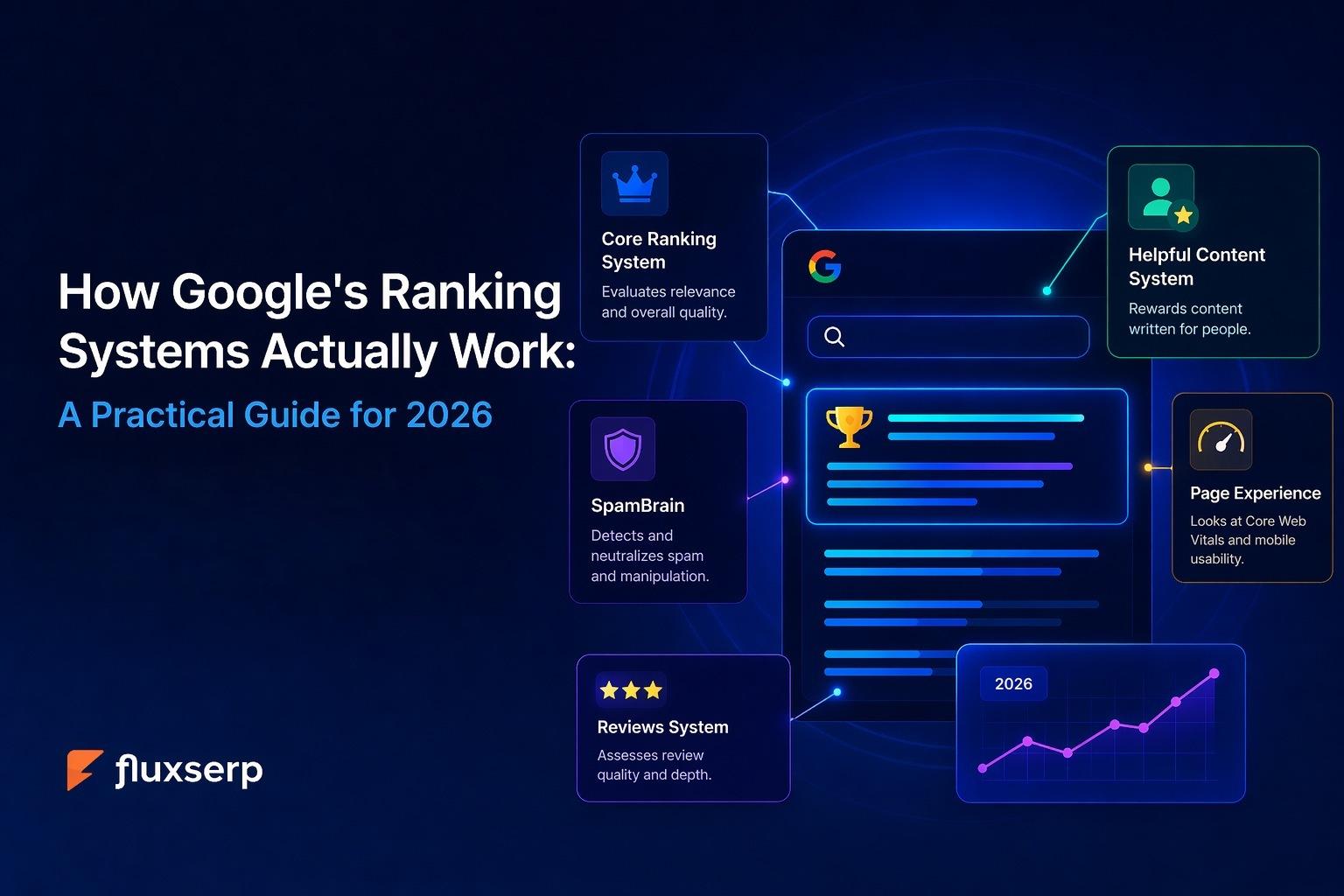
Most people picture Google's algorithm as a single formula that scores every page and outputs a ranked list. That picture is wrong, and it leads to bad decisions. When you believe there is one thing to optimize, you spend your time chasing the wrong signals while the real drivers of ranking stay invisible.
Google runs a collection of ranking systems, each responsible for evaluating a different dimension of a page and its context. These systems run in parallel, layered on top of each other, constantly processing signals across billions of pages and queries. Understanding this changes how you approach SEO at a fundamental level.
This guide explains how Google's ranking systems actually work, what has changed in 2026, what matters most right now, and how to build a practical strategy that holds up through updates rather than collapsing after each one.
Google Does Not Have One Algorithm. It Has Many.
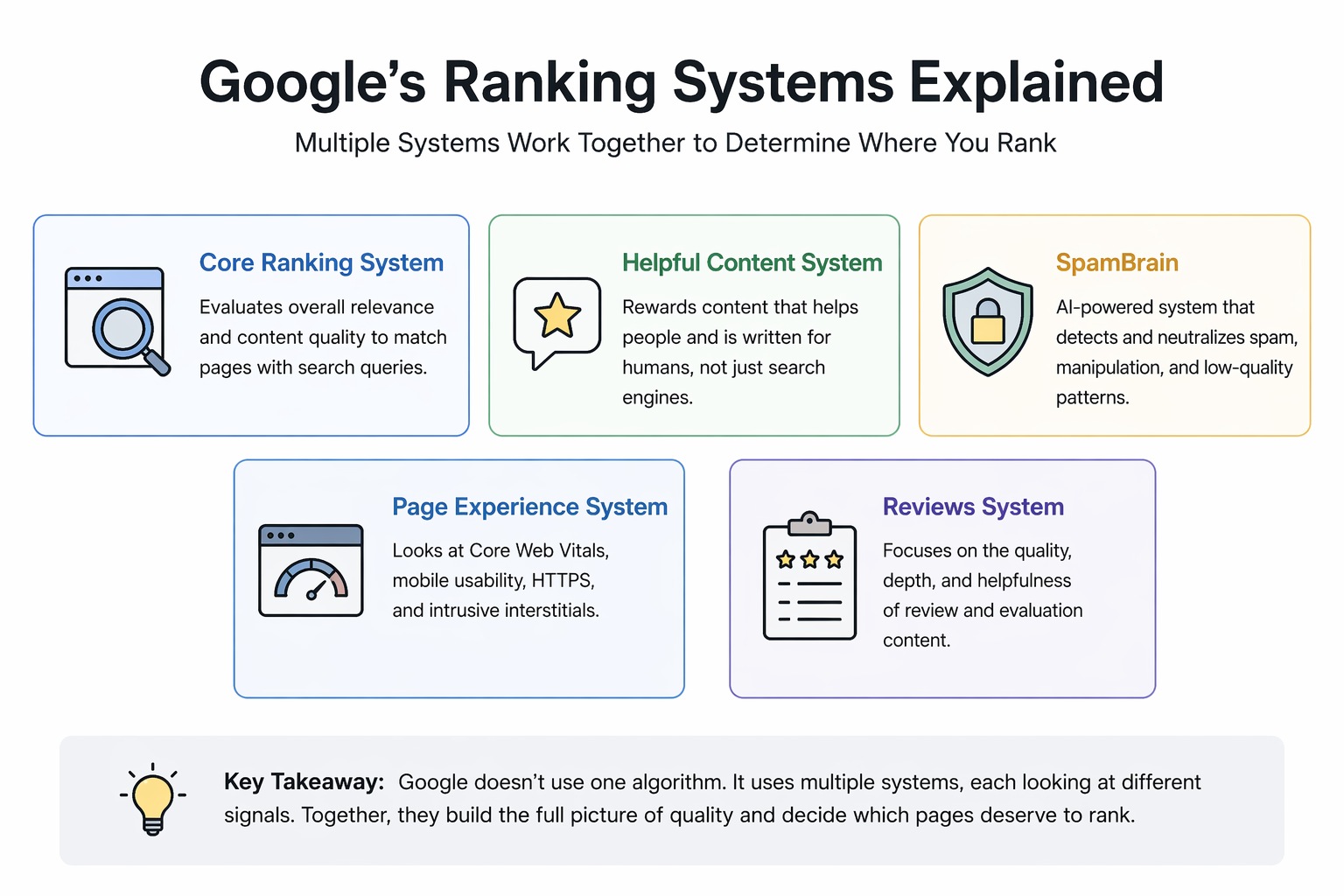
The term "Google's algorithm" is a simplification that causes real harm in practice. It implies a single system with a single set of levers. In reality, Google has confirmed the existence of multiple named ranking systems, each with its own focus:
Core ranking systems evaluate overall content quality and relevance to a query. The Helpful Content System specifically rewards content written for people rather than search engines. SpamBrain is an AI-powered spam detection system that evolves continuously to identify and neutralize manipulative patterns. The Page Experience system processes Core Web Vitals signals including loading speed, visual stability, and interactivity. The Reviews System assesses the quality and depth of review and evaluation content specifically.
Each of these systems operates with its own logic and contributes independently to where a page ranks. Think of it as a panel of specialists rather than a single judge. Each specialist evaluates a different aspect of your site, and the combined output determines your position.
This matters for a very practical reason. When your rankings change, the cause is rarely one thing. It is usually a combination of signals across multiple systems shifting simultaneously. Diagnosing what happened and what to fix requires understanding which system is most likely responsible for the change you are seeing.
How Core Updates Actually Work
Core updates are the most discussed and most misunderstood events in SEO. Every time Google announces one, forums fill with speculation, agencies send emails about "the algorithm change," and site owners make frantic edits to title tags and meta descriptions that accomplish nothing.
Here is what core updates actually are. They are broad recalibrations of how Google weighs signals across its ranking systems. They do not target individual tactics or keywords. They recalibrate the relative importance of quality signals across the entire web. A core update that rewards helpful content does not penalize any specific thing you did wrong. It changes where the quality bar sits for the category of content you are competing in.
This is why Google consistently says there is no specific fix for a core update. The advice to "produce great content" is not a non-answer. It is the accurate answer. If your content was helping users less effectively than competing pages, a recalibration that raises the weight on helpfulness signals will hurt you regardless of how well your technical setup is optimized.
The pattern of core updates from 2022 through 2026 shows a consistent direction. Each wave has increased the weight given to genuine expertise, real-world experience, author credibility, and content that satisfies the full intent behind a query rather than just matching its keywords. The Helpful Content System has been progressively more deeply integrated. Author entity signals, meaning verifiable connections between content and a real person with demonstrated expertise, have grown more prominent. Scaled content produced by automation without genuine expertise behind it has become increasingly difficult to rank sustainably.
What E-E-A-T Actually Means in Practice
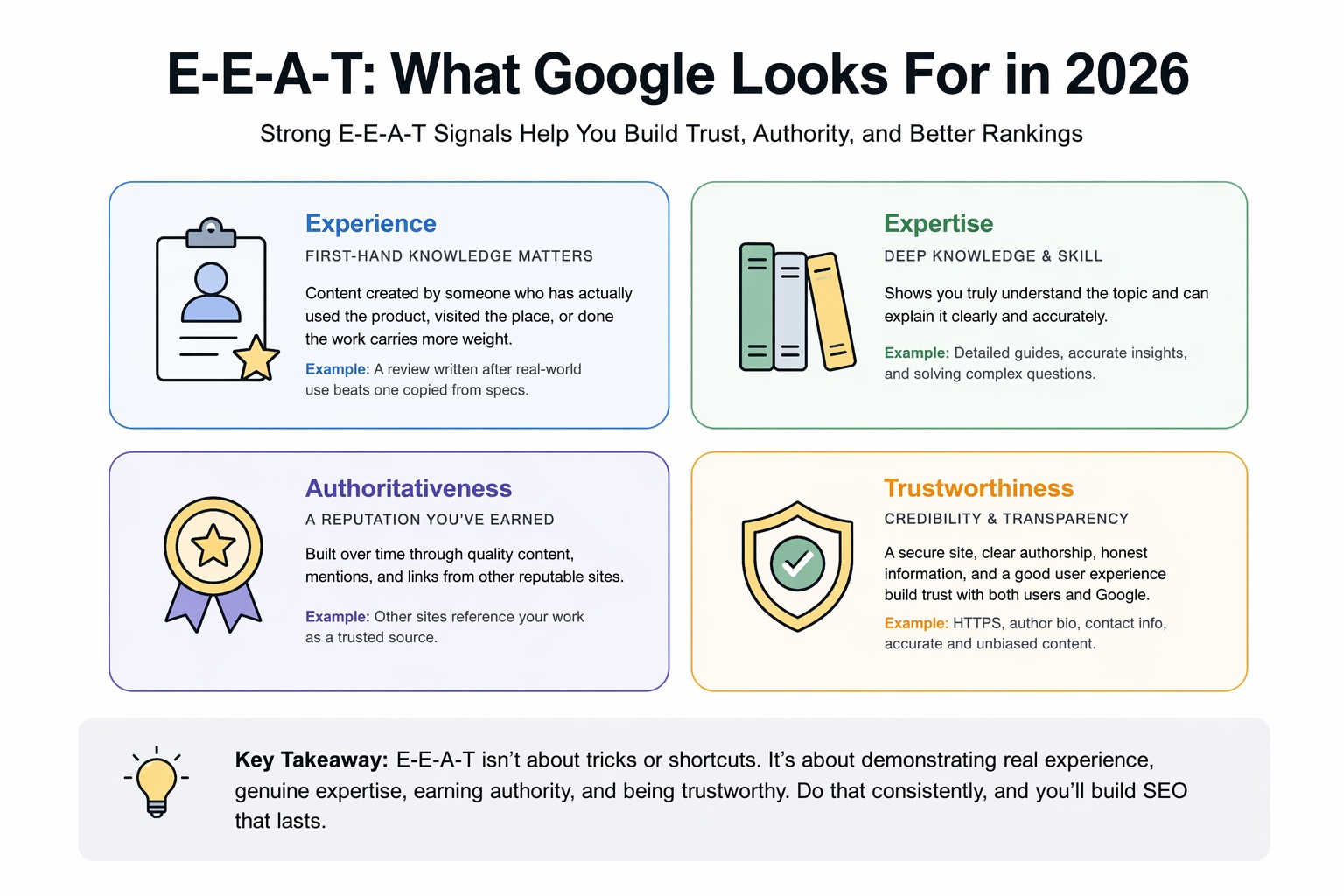
E-E-A-T stands for Experience, Expertise, Authoritativeness, and Trustworthiness. Google uses this framework in its Search Quality Evaluator Guidelines, and it describes the signals that its systems try to measure when assessing content quality.
Experience refers to whether the author or brand has direct, first-hand experience with the subject they are writing about. A review of a product written by someone who has actually used it carries different signals than one assembled from other reviews. A guide to running a restaurant kitchen written by someone who has worked in one reads and signals differently from one written by a generalist content writer.
Expertise refers to genuine subject matter knowledge. This does not mean academic credentials in every case, though credentials matter for topics like medicine and law. It means the content reflects real understanding of the topic rather than a surface-level summary of what other pages say.
Authoritativeness refers to the reputation your site and its authors carry within a subject area. When other credible, relevant sources reference and link to your content, that signals authority. A single viral link from an unrelated source matters far less than consistent references from publications operating in your space.
Trustworthiness refers to the basic signals of credibility: a secure site, transparent authorship, honest claims, clear business information, and the absence of patterns that suggest manipulation or deception.
For most businesses, E-E-A-T is an advantage rather than a barrier. You have real experience in your industry that generic content operations cannot replicate. A local accountant who writes about tax planning for small businesses with specific examples from their actual client work will consistently outperform a content farm producing generic tax guides. The specificity and the genuine knowledge are visible to both human readers and Google's quality systems.
Technical Signals: What They Can and Cannot Do
Technical SEO matters, but it operates as a baseline rather than a differentiator at the top of competitive categories. Core Web Vitals scores, mobile responsiveness, and page speed need to meet a minimum threshold. Below that threshold, even genuinely excellent content struggles to rank because poor technical performance is a negative signal. Above that threshold, content quality and relevance take over as the dominant factors.
This means fixing technical issues is almost always worth doing, but it rarely explains a significant ranking improvement on its own in a competitive space. A site with a perfect Core Web Vitals score but thin, unhelpful content will not outrank a site with good but not perfect technical performance and genuinely useful, expert-driven pages.
The technical areas worth prioritizing in 2026 are Largest Contentful Paint, which measures how quickly the main content of a page loads for users; Interaction to Next Paint, which measures responsiveness to user actions; Cumulative Layout Shift, which measures visual stability; and mobile usability, which affects a large and growing share of search traffic. Structured data also deserves attention, not because it directly improves rankings, but because it helps Google's systems understand what your content is about and makes you eligible for rich results that improve click-through rates from the SERP.
How AI Overviews Fit Into This Picture
Google's AI Overviews, which appear at the top of search results for a growing share of queries, do not operate as a separate ranking system with separate rules. They are built on top of the same signals and the same index that powers traditional organic rankings. This is important because it means your existing investment in quality content is directly relevant to AI Overview visibility.
AI Overviews use a technique called query fan-out, where the system breaks a single user query into multiple related sub-queries and retrieves content from pages that rank well for each of those sub-queries. Pages that rank across more of these related sub-queries are significantly more likely to be cited in the final AI Overview response.
The practical implication is that topical depth matters more than it ever has. A single page optimized for one keyword is less likely to be cited in an AI Overview than a cluster of interconnected pages that together cover a topic comprehensively. This aligns exactly with the topical authority signals that core ranking systems have been rewarding for several years.
The Practical Approach to Staying Aligned with Google's Systems
Understanding how the systems work is useful only if it leads to different decisions. Here is what that looks like in practice.
After any significant traffic change, wait at least two weeks before drawing conclusions. Core updates take time to fully roll out, and traffic fluctuations in the first days after an update are often noise rather than signal. Comparing your performance against direct competitors rather than just looking at your own numbers in isolation helps you distinguish between a broad market shift and something specific to your site.
Audit your lowest-performing pages for content depth and expertise signals before touching anything technical. The most common reason pages lose ranking in core updates is not a technical failure. It is that the content is less helpful or less authoritative than what is ranking above it. Shallow content that covers a topic partially, generic content that could apply to any business, and content without any genuine experience signals are all vulnerable.
Build a quarterly review cycle that covers four areas: Search Console performance data, content quality assessment for your most important pages, technical health checks for Core Web Vitals and mobile usability, and a competitor review to understand what is gaining ground in your target queries. Treat this as maintenance, not crisis response.
Publish improvements steadily rather than in bursts. Google's systems respond to patterns of quality over time. A sustained program of improving your most important pages consistently produces better results than a one-time site-wide overhaul followed by neglect.
Frequently Asked Questions
What is the difference between a core update and other Google updates?
Core updates are broad recalibrations of how Google weighs quality signals across its entire ranking systems. They affect how all content is evaluated, not just content in a specific category or using a specific tactic. Other updates tend to be more targeted, such as spam updates that specifically address manipulative link patterns or product reviews updates that focus on that content type specifically.
Does AI-generated content get penalized by Google?
Google does not penalize content based on how it was produced. The question its systems ask is whether the content is helpful, accurate, and backed by genuine expertise. Thin, generic AI-generated content without real knowledge behind it performs poorly because it fails those quality tests, not because it was generated by AI. AI content that has been reviewed, enriched with real expertise, and genuinely serves user needs can rank as well as any other content.
How long does it take to recover from a core update ranking drop?
Recovery timelines vary significantly. Sites that have clear quality gaps in their content and make genuine improvements typically begin to see recovery within one to three months. Some sites recover faster, some take longer, and some do not recover until the next core update provides another opportunity for recalibration. The key variable is whether the improvements made are genuinely meaningful to users or are surface-level edits that do not change the underlying quality of the content.
Do backlinks still matter for Google rankings in 2026?
Backlinks remain an important signal, particularly for establishing authoritativeness. However, their weight has shifted. Links from relevant, credible sources within your subject area carry significantly more value than high volumes of links from unrelated or low-quality sources. The emphasis on E-E-A-T has made the quality and relevance of links more important than their quantity.
How do I know which Google ranking system is affecting my site?
You cannot directly observe which system is responsible for a ranking change, but you can make informed diagnoses. If your rankings dropped during or after a core update and your content has not changed significantly, the issue is likely content quality relative to competitors. If rankings dropped after a spam update and you have aggressive link building in your history, that is the likely cause. If mobile traffic specifically declined, Page Experience signals are worth investigating. Analyzing the pattern of what changed, when it changed, and which pages were affected helps narrow down the responsible system.
Is it possible to build SEO that is largely update-proof?
No SEO strategy is entirely immune to algorithm changes. However, strategies built on genuine content quality, real expertise, strong topical authority, and honest technical practices are consistently more resilient than strategies that rely on any specific tactic or shortcut. The businesses that weather updates most consistently are those that would have produced the same content even if Google's systems did not exist, because they are genuinely trying to serve their audience rather than game a ranking system.
Building SEO that lasts requires accepting that there is no shortcut that stays open indefinitely. The brands appearing consistently across Google's traditional results and AI Overviews got there through the same path: producing genuinely useful content for real people, building credibility in their subject area over time, and maintaining the technical basics that allow Google to access and understand what they publish.
See How Your Site Performs in AI Search Right Now
FluxSERP tracks your visibility across Google AI Overviews, traditional rankings, and competitor positions so you know exactly where to focus your SEO effort.
Start for Free
Catalin Dinca
Written by Catalin Dinca