

How SEO builds brand awareness: the 2026 strategy that actually compounds
 Catalin Dinca
Most businesses treat SEO as a traffic machine. You publish content, rank for keywords, and watch visitors arrive. That model is not wrong exactly. It is just incomplete. The bigger opportunity lies in what happens before anyone clicks. Every time your brand appears in search results — on page one or even page two — it registers in the user's memory. Over time, those repeated exposures build something far more valuable than a single visit: recognition, trust, and the instinct to search for you by name.
That is the real brand-building power of SEO, and it is what most businesses leave untouched when they focus only on click-through rates and keyword rankings.
How SEO Fuels Brand Awareness Before Anyone Even Clicks
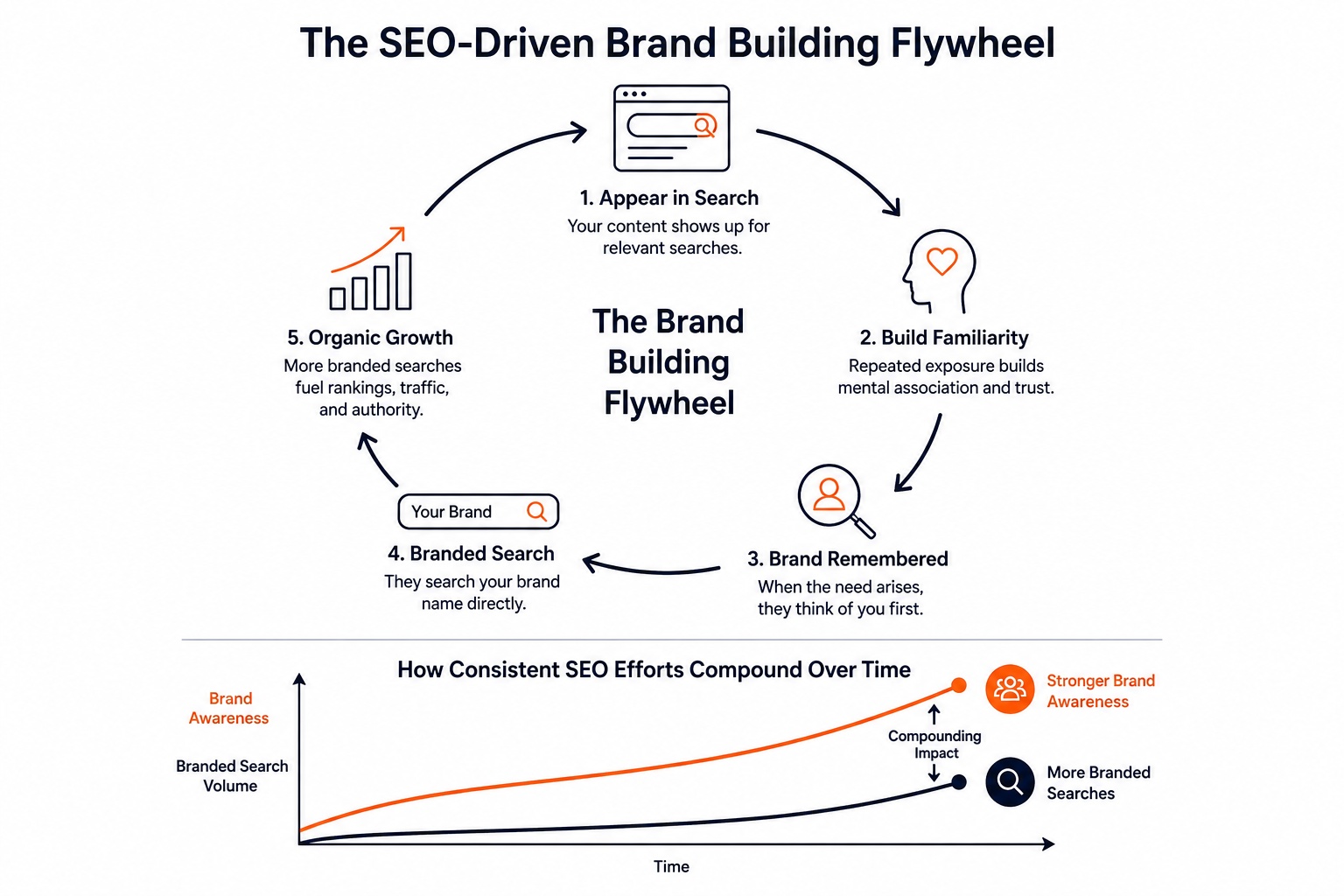
Think about how search-driven brand building actually plays out. A user searches "how to manage team projects" and sees your brand's article. Two weeks later, they search "project management tools comparison" and there you are again. A month after that, they search for your brand name directly. You did not convert them on the first visit. But you built the mental association that made them come back and convert later on their own terms.
Branded search volume — how often people type your company name directly into Google — is one of the clearest signals that SEO-driven brand awareness is working. When branded searches increase alongside your content efforts, the exposure is sticking. It is a metric that most small and mid-size businesses ignore, which is a significant missed opportunity.
SEO-driven brand awareness produces several compounding benefits that paid advertising cannot replicate. Repeated appearances in search results build mental shortcuts in your audience's mind, so they think of you first when the need arises. Ranking for informational and industry-specific queries positions you as a credible expert before someone is ready to buy. You appear to users who have never heard of you but are searching for problems you solve, which expands reach without increasing spend. Users perceive organic results as more credible than paid ads, which boosts your brand's reputation by association. And unlike paid campaigns, organic visibility continues producing impressions after you stop actively publishing new content.
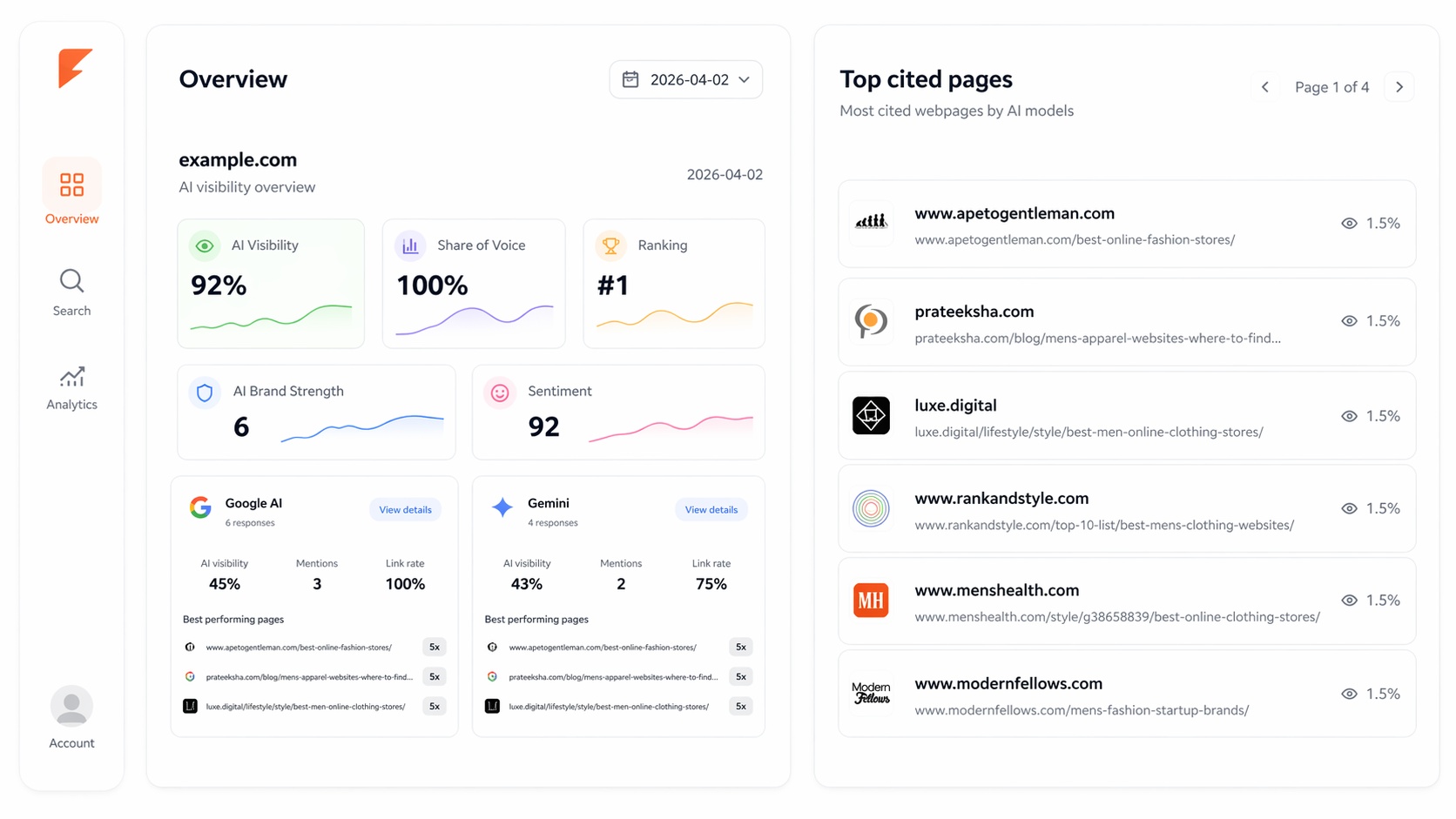
The AI visibility tracking tool in FluxSERP makes it possible to monitor exactly where your brand is appearing across both traditional search results and AI-generated answers, which gives you the full picture of your brand's search presence rather than just the clicks that make it into your analytics.
The Core SEO Strategies That Build Lasting Brand Recognition
Understanding the mechanics of SEO-driven brand building is only the starting point. The practical question is which strategies actually produce compounding brand recognition rather than one-time traffic spikes.
Building topical authority through content clusters is the most durable approach. Instead of publishing disconnected blog posts across random topics, group your content around central themes. Create a pillar page on a broad topic, then support it with detailed subtopic articles that link back to the pillar and to each other. This structure signals to search engines that you understand your field deeply, and it keeps users moving through your content and encountering your brand at multiple touchpoints. A visitor who reads three of your articles in a session is far more likely to remember your brand than someone who reads one and leaves.
Applying E-E-A-T signals consistently is no longer optional for brands that want long-term visibility. E-E-A-T stands for Experience, Expertise, Authoritativeness, and Trustworthiness. These are the criteria Google uses to evaluate whether content deserves to rank and whether the brand behind it deserves authority. Author bios with real credentials, original data and research, external citations, and consistent publishing under a recognizable brand name all strengthen these signals. The brands that built genuine E-E-A-T signals before 2024 have proven significantly more resilient through the rounds of core updates and AI search changes that followed.
Targeting non-branded keyword clusters is how new audiences discover you for the first time. If you sell email marketing software, you want to rank for "how to write a welcome email," "email open rate benchmarks," and "newsletter frequency best practices." These informational searches are where potential customers first encounter your brand while looking for answers, not products. The FluxSERP SEO toolkits include keyword clustering tools that group non-branded terms by topic and intent, making it practical to build out topical coverage systematically rather than guessing which topics to prioritize.
Optimizing internal linking and schema markup turns a collection of individual pages into a coherent brand signal. Internal links help both users and search engines navigate your content, distribute authority across your site, and surface related content that keeps visitors engaged. Schema markup provides Google with structured context about your content, making your listings more visually prominent in search results and increasing the likelihood that your content is selected for featured snippets and AI Overview citations.
| Factor | Brand-driven SEO | Traffic-only SEO |
|---|---|---|
| Primary goal | Build recognition and authority | Drive clicks and sessions |
| Content focus | Topical depth, expert voice | Keyword density, volume output |
| Key metrics | Branded searches, return visits | Organic sessions, bounce rate |
| Long-term value | Very high — compounds over time | Moderate — requires continuous output |
| AI search compatibility | Strong — brand signals carry over | Weaker — generic content gets bypassed |
Measuring Brand Awareness Growth Through SEO: The Metrics That Matter
SEO is one of the most measurable marketing investments available. A meta-analysis of ten studies spanning 2022 to 2024 showed that SEO produces a high effect size in improving organic rankings and traffic — substantial and replicable across different industries and company sizes. The average ROI benchmark across SEO programs sits at 748%, making it one of the highest-returning organic channels available.
But the metrics most businesses track — sessions, rankings, and bounce rates — are downstream of brand awareness. The metrics that specifically tell you whether SEO is building your brand require a slightly different measurement setup.
Branded search volume tracked through Search Console shows how many people are searching your company name directly. An increase in branded searches that correlates with your content publication efforts is the clearest signal that the exposure is converting into recall. Direct traffic trends tell a similar story — an increase in direct visits often reflects growing brand recall from organic exposure rather than visitors who came through a link.
Return visitor rate is a particularly revealing metric. Users who visit your site more than once are beginning to associate your brand as a trusted resource, which is exactly the kind of behavior that precedes conversion and long-term loyalty. Impression share in Search Console shows how often your brand appears in results even when users do not click through, which is the part of your brand building activity that most analytics platforms never capture.
The FluxSERP AI SEO tool surfaces these brand signals alongside traditional ranking data, connecting the dots between content publication activity, search impression growth, branded search increases, and AI search citation patterns in a way that makes it clear which efforts are building brand authority and which are just generating one-time traffic.
AI Search, Zero-Click SERPs, and Why Brand Signals Now Set the Ranking Ceiling
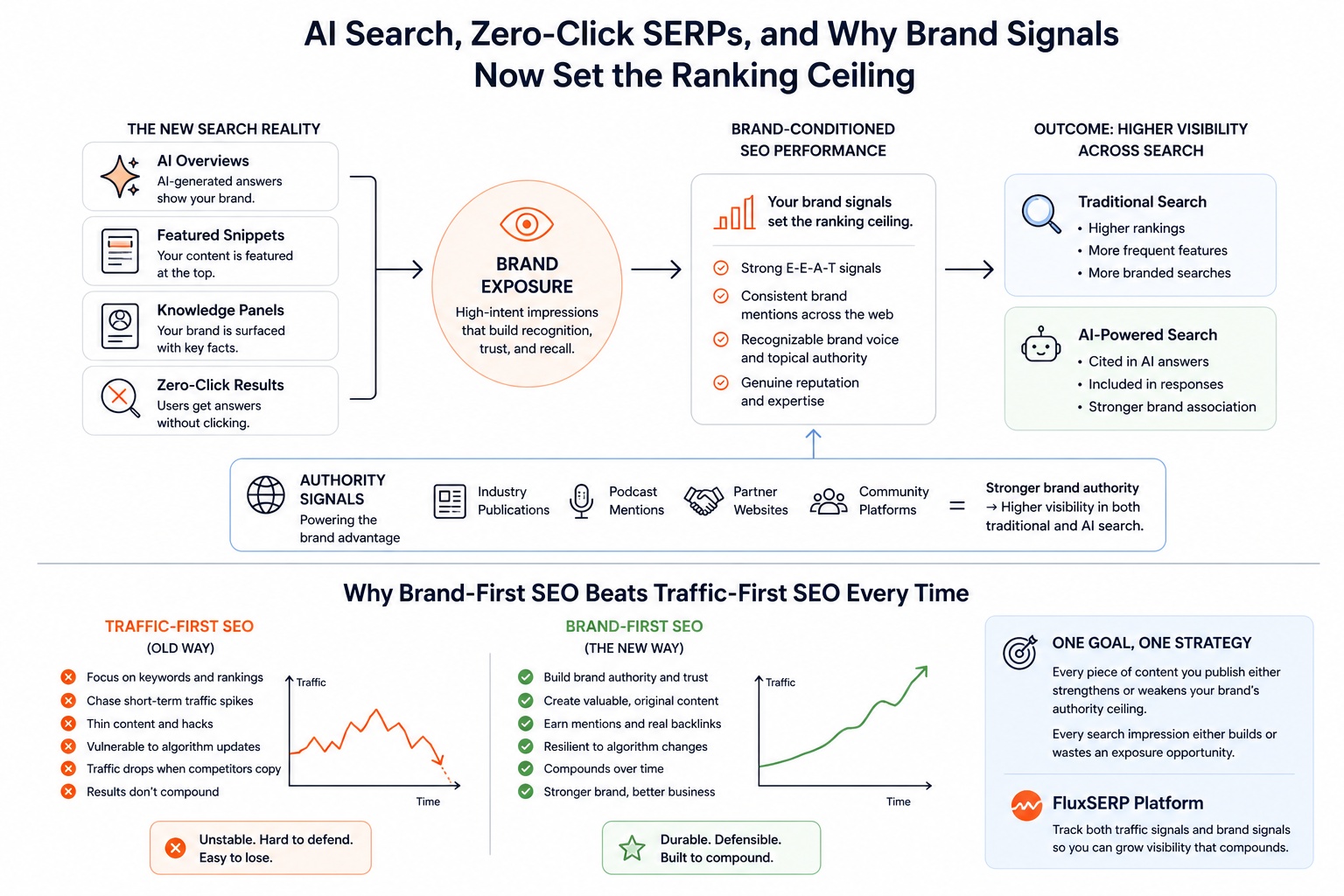
The most significant shift in search right now is not a new algorithm. It is the structural change in how users receive information. AI-generated answers, featured snippets, knowledge panels, and zero-click results now satisfy a meaningful percentage of informational queries without users ever visiting a website. At first glance, this sounds terrible for organic traffic. The counterintuitive reality is that these formats are the most powerful brand exposure mechanisms in the history of search.
When your content is featured in a Google AI Overview, your brand name appears prominently in the response regardless of whether the user clicks through. When ChatGPT cites your research, your brand is associated with expertise in the minds of every person who reads that response. These are brand impressions at scale in contexts where the user is actively engaged with the topic, which makes them more memorable than a standard search result listing.
The research framing this shift describes the current era as "brand-conditioned SEO performance." What this means practically is that your brand's overall authority and reputation now sets a ceiling on how high you can rank and how frequently you appear in AI-generated answers, regardless of how technically optimized your individual pages are. Strong E-E-A-T signals, consistent brand mentions across the web, and a recognizable brand voice that AI systems can associate with genuine expertise are what determine that ceiling.
Building brand presence across third-party sources — industry publications, podcast mentions, partner websites, and community platforms — feeds directly into the authority signals that AI search platforms use to decide whose content to surface. These off-page signals are increasingly as important as the on-page factors that traditional SEO focused on. Understanding how to rank in ChatGPT and AI search surfaces is now a core component of any brand-building SEO strategy, not a separate specialization.
Why Brand-First SEO Beats Traffic-First SEO Every Time
Old-school SEO was about gaming algorithms. Enough keywords, enough links, and rankings followed. That era is over. The brands winning in search today would rank even if the algorithm changed tomorrow because their authority is genuine rather than manufactured.
Brand-first SEO is not a softer strategy. It is actually more durable and more difficult to replicate. When you invest in building a recognizable brand through search, you stack benefits that persist through algorithm updates, AI platform shifts, and competitive changes. Traffic-first SEO collapses whenever Google adjusts how it rewards thin content, which it does consistently and without warning.
The mistake many business owners make is treating brand awareness and SEO as separate budgets with separate goals. They are not. Every piece of content you publish either strengthens or weakens your brand's authority ceiling. Every search impression either builds or wastes an exposure opportunity. The brands that compound their SEO advantage over time are the ones that understand this connection and build their content strategy around it. The FluxSERP platform is designed to give you the visibility you need to manage this kind of brand-building SEO program systematically, tracking both the traffic signals and the brand signals that together tell you whether your investment is compounding.
Frequently Asked Questions
What is the relationship between SEO and brand awareness?
SEO increases brand awareness primarily through repeated visibility in search results. Every time your brand appears in results for a relevant query, it plants a memory in the user's mind. Over repeated exposures across different searches, that memory strengthens into recognition, trust, and eventually the habit of searching for your brand by name. Branded search volume growth is the most direct measurement of this effect.
How does AI search change SEO's impact on brand building?
AI search intensifies the importance of brand authority. In the current environment, your brand's overall strength — measured in E-E-A-T signals, consistent mentions across the web, and recognized expertise — sets the ceiling for how high you can rank and how often your content appears in AI-generated answers. Brands with genuine authority get cited more frequently in AI Overviews and ChatGPT responses, which creates brand impressions in highly engaged contexts that are more memorable than standard search listings.
Which metrics best indicate whether SEO is building brand awareness?
Branded search volume, tracked through Search Console, is the most direct signal. Direct traffic growth often reflects increasing brand recall from organic exposure. Return visitor rate shows whether first-time visitors are developing a habit of returning to your brand as a trusted resource. Impression share shows how often your brand appears even when users do not click. Together, these metrics paint a picture of brand building that standard traffic analytics misses entirely.
Can a small business compete on brand-building SEO against larger competitors?
Yes, and often more effectively in niche areas. Large competitors have the resources to rank broadly, but they frequently lack the depth and specificity that a smaller, focused brand can provide on the topics that matter most to a particular audience. Building topical authority in a specific niche consistently outperforms broad coverage done shallowly, and it is achievable with a much smaller content budget than general SEO competition requires.
How long does it take for SEO to build measurable brand awareness?
Brand awareness signals typically begin moving within three to six months of consistent content publication. Branded search volume growth usually becomes measurable after six months of sustained effort. The compounding nature of SEO-driven brand awareness means the curve accelerates over time rather than plateauing, so brands that start early and stay consistent see dramatic differences in brand authority after twelve to twenty-four months compared to brands that take a stop-start approach.
What is the difference between topical authority and general keyword ranking?
Topical authority means your brand is recognized by search engines as a comprehensive, trusted source on a specific subject area. General keyword ranking means individual pages rank for specific terms without necessarily signaling broader expertise. Topical authority produces more durable rankings, better performance across long-tail queries, higher likelihood of being cited in AI-generated answers, and stronger brand recognition because users encounter your content repeatedly across the full range of a topic rather than on a single entry point.
Organic search is not just a traffic channel. It is a brand-building engine that runs continuously, reaching users at the exact moment they are curious about what you offer and repeatedly associating your brand with the expertise they are looking for. The businesses that understand this distinction and build their SEO strategy around it are the ones that compound their market position year over year rather than chasing traffic numbers that reset every time the algorithm shifts.
See Where Your Brand Appears Across Google and AI Search
FluxSERP tracks your keyword rankings, branded search growth, AI Overview citations, and competitor positions so you always know whether your SEO is building real brand authority or just generating traffic that does not stick.
Start for Free
Catalin Dinca
Written by Catalin Dinca