

Boost Your SEO With AI in 2026: The Practical System That Drives Compounding Growth
 Catalin Dinca
There are two ways to grow your SEO output. The first is the traditional approach: hire more people, produce more content, review more pages, spend more time. Many teams have done this and found that results scale slowly relative to the effort invested. The second approach is to use AI to remove the structural bottlenecks that limit how much a team of any size can actually accomplish.
Using AI to boost your SEO does not mean replacing your team with scripts. It means identifying the tasks that are genuinely repetitive, high-volume, and low-judgment, and building systems that handle those tasks reliably so your team can focus on the work that actually requires strategic thinking. When this is done correctly, a small team can outproduce a much larger operation running on manual processes.
This guide explains the practical system for boosting your SEO with AI in 2026, which tools and methodologies produce real results, where AI consistently falls short and what to do about it, and how to measure whether what you are doing is actually working.
Why AI Changes the SEO Growth Equation
Traditional SEO scales linearly. Every additional page, every additional keyword cluster, every additional technical fix requires roughly proportional human effort. There is a ceiling determined entirely by team capacity, and raising that ceiling means adding headcount or sacrificing quality.
AI-assisted SEO scales differently. The systems you build to handle content generation, technical auditing, keyword clustering, and internal linking operate at speeds and volumes that manual processes cannot match. More importantly, well-designed systems improve over time. The output compounds because each refinement you make to the process applies to everything the system produces going forward.
The practical result is that the question "how many people do we need to grow SEO?" gets replaced by "how well have we designed our systems?" These are very different questions with very different answers. The FluxSERP AI toolkits are built around exactly this model, giving teams the infrastructure to run AI-assisted SEO workflows without needing to build custom tooling from scratch.
The Four Areas Where AI Delivers Real SEO Lift
Teams that successfully boost their SEO with AI are typically working across four connected areas simultaneously. Trying to automate only one while leaving the others manual creates bottlenecks that limit what the automation can actually produce.
The first area is content generation and optimization. AI systems can produce, rewrite, and improve content at volumes that no manual team can match. The critical constraint here is not the AI's ability to generate words. It is the quality of the input: what keyword data, intent analysis, and competitive intelligence the system has access to before it writes anything. Feed it good inputs and you get content that serves real user needs. Feed it generic prompts and you get generic output that fails quality evaluation. The FluxSERP AI SEO tool handles this input layer, surfacing the intent signals and keyword context that make automated content genuinely useful rather than just voluminous.
The second area is technical SEO at scale. Schema markup, meta descriptions, canonical tags, heading hierarchies, and internal link structures are all tasks that follow defined rules and can be managed programmatically across thousands of pages simultaneously. This is often where the fastest measurable wins appear because technical issues are widespread on most sites and fixing them manually takes weeks that automation compresses into hours.
The third area is keyword clustering and content planning. Manually sorting through hundreds of keyword variations by intent, topic, and competitive difficulty is one of the most time-consuming parts of SEO planning. AI clustering tools group terms semantically, catching relationships that manual sorting misses, and translate directly into structured content calendars that take days rather than weeks to build.
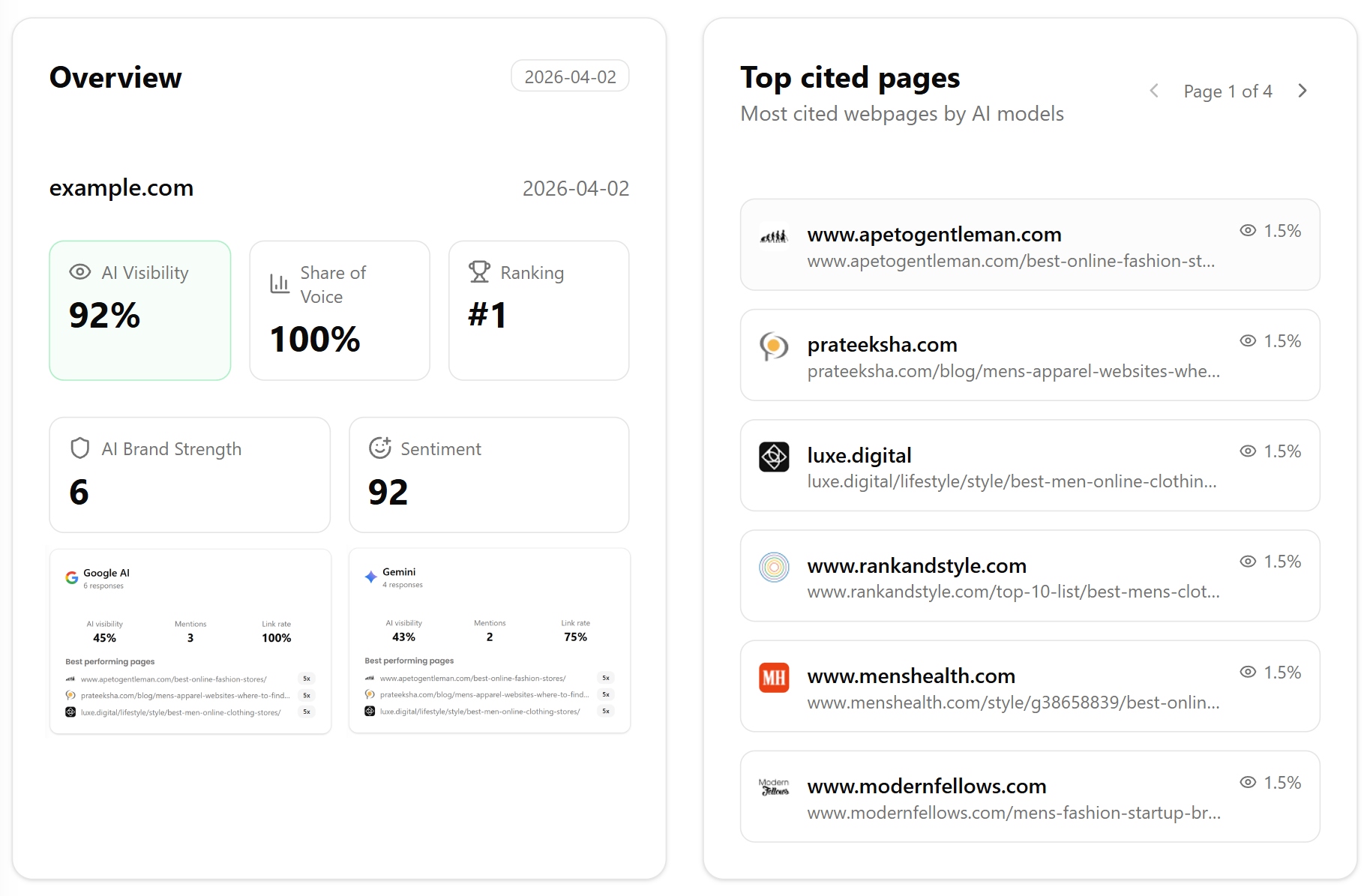
The fourth area is AI search visibility. In 2026, appearing in traditional organic results is necessary but no longer sufficient. AI Overviews, ChatGPT, Perplexity, and other AI-powered search surfaces are handling a growing share of informational queries, and they have their own citation logic. The AI visibility tool from FluxSERP tracks where your content appears across these AI surfaces, which prompts trigger mentions of your brand, and how your AI search presence compares to competitors.
What the Data Shows About AI-Assisted SEO
The performance difference between manual and AI-assisted SEO approaches is not marginal in well-documented cases. Analysis across nearly 40,000 sites that implemented automated technical SEO fixes showed impression growth of 146%, an average gain of 67 additional ranking keywords per site, and a 2-position improvement in average ranking position. These outcomes happened without adding writers or strategists to the teams involved.
Beyond technical automation, programmatic content at scale has demonstrated the ability to generate meaningful organic revenue from a standing start, and autonomous monitoring systems have been documented producing traffic lifts exceeding 300% compared to equivalent sites relying entirely on manual processes.
| SEO task | Manual approach | AI-assisted approach |
|---|---|---|
| Content output | 5–20 pages per month | Hundreds to thousands per month |
| Technical audit and fix cycle | Days to weeks per issue | Minutes to hours at scale |
| Keyword cluster research | 1–2 weeks per topic area | Hours with semantic grouping |
| AI search monitoring | Not practically possible manually | Continuous, automated tracking |
The Hybrid Model: Where AI Handles Volume and Humans Handle Judgment
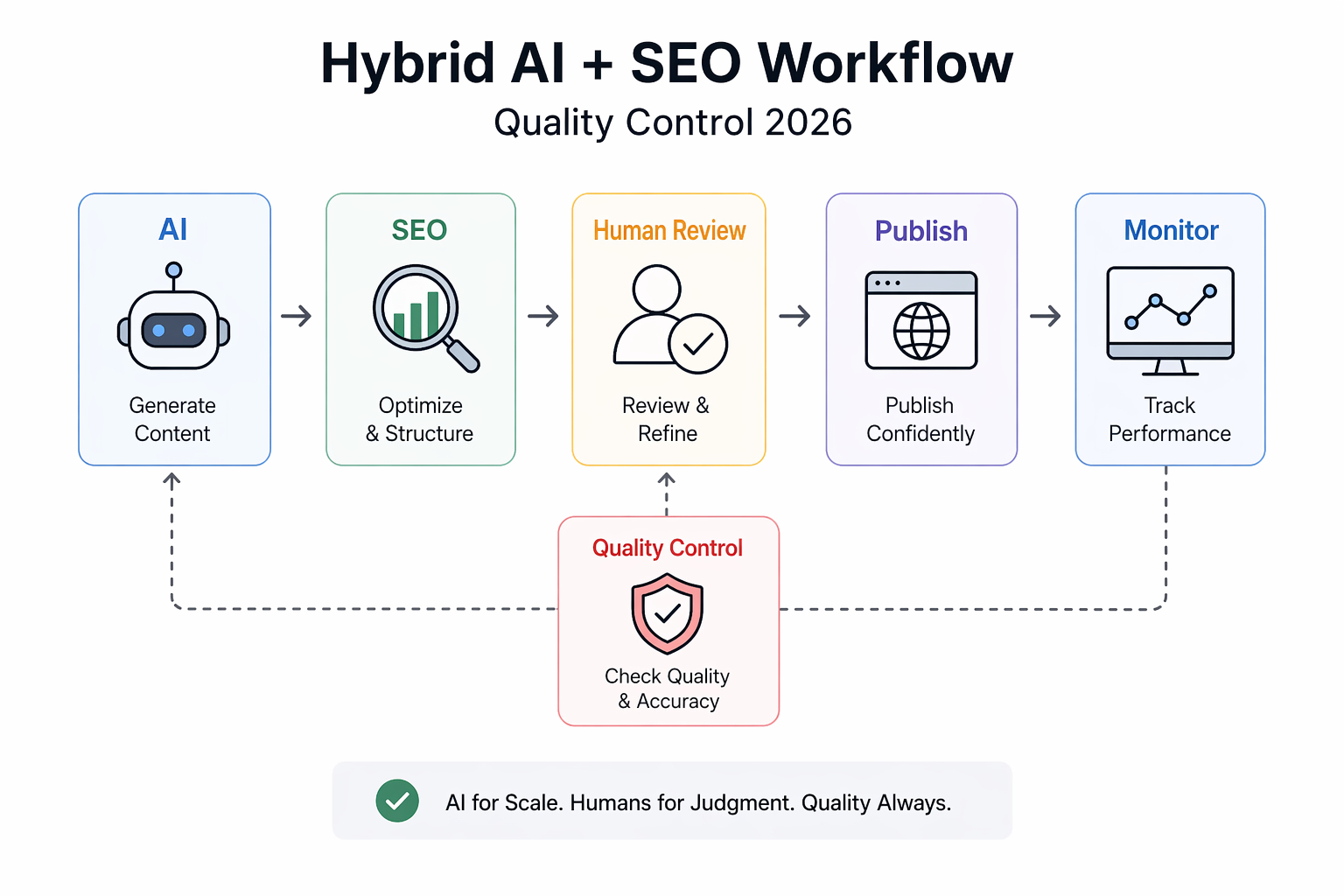
The teams that get sustainable results from AI-assisted SEO are not running fully autonomous operations. They are running hybrid systems where AI handles high-volume, rule-based work and humans handle the judgment calls that AI consistently gets wrong.
Understanding where that boundary sits matters. AI handles content generation from structured inputs reliably. It does not reliably maintain brand voice consistency across large page sets without human review. It handles technical SEO rule application well. It does not handle niche industry context or product-specific accuracy without human input. It surfaces keyword relationships at scale. It does not reliably distinguish between keywords that look related and keywords that serve genuinely different buyer intents without human validation of each cluster.
Building quality checkpoints into your AI workflows is not optional. It is the difference between a system that compounds your results and one that compounds your problems. Set up automated quality scoring that flags content below a minimum threshold before it is published. Build editorial review into your workflow at the page type level rather than relying on spot checks. Monitor indexation and engagement rates, not just page counts, because a site with 10,000 pages engaging users meaningfully is more valuable than 20,000 pages that get crawled and ignored.
The full feature set on FluxSERP is designed around this hybrid model, providing the infrastructure for both the AI-driven volume layer and the monitoring layer that tells you what the volume is actually producing.
How to Build the System: Implementation Sequence That Works
Sequencing matters more than tool selection when implementing AI-assisted SEO. Teams that try to automate everything simultaneously create more problems than they solve. The approach that consistently produces results builds in layers, validates each layer before adding the next, and treats each automation component as a system to train rather than a switch to flip.
Start with metadata and internal linking. These are the lowest-risk, highest-impact starting points because the rules are defined, the output is measurable, and the consequences of errors are contained. Getting confident in your automation stack at this layer builds the foundation for everything that follows.
Add programmatic content for structured page types next. Location pages, FAQ pages, and product listing pages are natural first candidates because their content is predictable, their intent is consistent, and their performance is easy to measure. Use your own data as the input rather than relying on AI to generate differentiation from nothing, because uniqueness comes from the data, not the template.
Layer in keyword clustering and content planning automation once your production pipeline is running cleanly. This is where the time savings become dramatic because the research and planning work that previously consumed weeks of analyst time compresses into hours.
Build AI search monitoring last because it requires the other layers to be producing content and rankings before there is meaningful data to monitor. Tracking your presence in AI Overviews and other AI-powered surfaces through the guide on ranking in ChatGPT and AI search gives you the strategic context for understanding what your content needs to do to get cited.
Tracking Results: The Metrics That Tell You Whether AI SEO Is Working
Publishing content and fixing technical issues is step one. Knowing whether those efforts are producing results is where most teams have gaps. The metrics that matter for AI-assisted SEO are more specific than general traffic numbers.
Rankings for target keyword clusters tell you whether your optimization is gaining traction. Organic traffic to optimized pages tells you whether better rankings translate to actual visitors. Conversion attribution by keyword tells you whether the traffic is producing business outcomes. AI search citation tracking tells you whether your content is appearing in AI-generated answers for the queries that matter to your audience.
Search Console remains the foundation for traditional ranking data, and the Google Search Console guide for 2026 covers how to extract the specific signals most relevant to monitoring an AI-assisted SEO program. For AI search visibility specifically, the FluxSERP AI visibility tracking tool monitors which prompts trigger mentions of your brand across seven major AI platforms and shows how that visibility is changing over time.
Frequently Asked Questions
What does it mean to boost SEO with AI in practice?
In practice, boosting SEO with AI means using AI tools to handle the high-volume, repetitive parts of SEO work at speeds and scale that manual processes cannot match. This includes content generation from keyword data, technical SEO management across thousands of pages, semantic keyword clustering, internal link optimization, and monitoring your presence across both traditional and AI-powered search surfaces. The human role shifts from executing these tasks to designing the systems, reviewing the output quality, and making the strategic decisions that AI gets wrong.
Which AI SEO tools actually produce measurable results?
The tools that produce consistent results share two characteristics: they are designed around specific, well-defined tasks rather than trying to do everything, and they produce output that can be measured and validated against real performance data. For tracking and analysis, FluxSERP's SEO toolkits cover ranking monitoring, AI citation tracking, and competitor analysis. For content and technical work, tools that integrate directly with your publishing workflow and your Search Console data tend to produce more actionable output than standalone generators.
How long does it take to see results from AI-assisted SEO?
Technical SEO automation typically produces measurable results within 30 to 60 days because fixing indexation and structure issues has relatively direct effects on crawling and ranking. Programmatic content takes longer because new pages need to be crawled, indexed, and evaluated over time. Most teams see meaningful traffic lifts from content automation within 60 to 90 days of deployment, assuming the content meets quality thresholds and the site already has sufficient domain authority to rank competitively.
Does AI content get penalized by Google?
Google does not penalize content based on how it was produced. The question its ranking systems ask is whether the content is genuinely helpful, accurate, and backed by real expertise. Thin, generic AI-generated content without real knowledge behind it performs poorly because it fails quality evaluation, not because it was generated by AI. AI content that has been reviewed, enriched with specific expertise, and genuinely serves user needs can rank as well as any other content. The risk is not using AI. The risk is using AI to generate volume without maintaining quality standards.
How do AI search surfaces like ChatGPT and AI Overviews fit into an SEO strategy?
AI search surfaces use the same underlying index as traditional organic rankings but apply additional filtering based on topical authority, content structure, and citation patterns. Content that ranks well in traditional search is a prerequisite for appearing in AI-generated answers, but ranking alone is not sufficient. Pages that get cited in AI Overviews tend to have explicit answers to specific questions, strong internal linking across a topic cluster, and sufficient review volume or authority signals. Building an SEO strategy that serves both traditional and AI-powered search is not a separate workflow. It is the same quality-focused approach applied consistently.
What is the biggest mistake teams make when implementing AI SEO tools?
Prioritizing volume over quality control at the implementation stage. Teams that publish thousands of AI-generated pages without building editorial review and quality scoring into their workflow often see short-term impression gains followed by ranking deterioration when Google's quality evaluation systems catch up with the content. The sustainable approach publishes fewer pages at a time, validates quality rigorously, and scales only after the quality baseline is consistently met.
The brands that consistently appear across both traditional Google results and AI-powered search surfaces got there through the same path: producing genuinely useful content, building topical authority over time, and using AI to scale the execution of that strategy rather than to replace the strategy itself. That is what boosting SEO with AI actually looks like when it works.
Track Every AI and Traditional Search Win in One Place
FluxSERP monitors your rankings, AI Overview citations, and competitor movements so you can see exactly what your SEO efforts are producing and where to invest next.
Start for Free
Catalin Dinca
Written by Catalin Dinca