

Website Audit in 2026: The Complete AI-Powered Guide to Fixing What's Hurting Your Rankings
 Catalin Dinca
Most businesses treat a website audit the same way most people treat a doctor visit: something you do when something already hurts. That approach is quietly costing rankings, leads, and revenue. By the time a ranking drop appears in your analytics, the underlying issue has typically been present for weeks or months. A proactive, structured audit finds those issues before they become problems you are scrambling to explain to a client or a manager.
The good news is that AI has fundamentally changed how long an audit takes and how much technical expertise you need to run one effectively. What used to require days of manual checking by a specialist can now be completed in a fraction of the time, with better coverage and clearer prioritization of which issues actually matter. This guide explains what a website audit covers, which types of audit address which problems, how to build a practical workflow that produces real results, and how AI fits into each stage of the process.
What a Website Audit Actually Covers
A website audit is a structured evaluation of everything that affects how your site performs in search and how it converts visitors once they arrive. The scope is broader than most people expect when they hear the term.
A thorough audit looks at how search engine crawlers navigate your pages, whether the pages that matter most are actually indexed, how fast content loads on mobile, whether your metadata is doing its job, how your internal link structure guides both users and bots, whether your backlink profile is helping or hurting domain authority, and whether your content is genuinely relevant and comprehensive for the queries you are targeting.
Each of these dimensions can create invisible drag on your performance. You can have excellent content that never ranks because a crawl error is blocking the page from being indexed. You can have pages that are indexed but invisible because the metadata is missing or misleading. You can have technically clean pages that fail to convert because the user experience creates friction at every step. A real audit surfaces all of it, not just the easy-to-find errors.
| Audit area | What it examines | Common issues found |
|---|---|---|
| Technical SEO | Crawlability, indexing, site speed | Broken redirects, slow pages, duplicate content |
| Content quality | Relevance, depth, keyword coverage | Thin pages, keyword gaps, missing metadata |
| UX and design | Navigation, mobile usability, CTAs | Poor CTA placement, confusing layout, friction |
| Backlink profile | Link quality, domain authority signals | Toxic backlinks, low domain authority |
| Crawlability | Site architecture, internal links | Orphaned pages, crawl errors |
The most important takeaway about what auditing is: it is a diagnostic tool. It tells you what is already happening beneath the surface so you can fix it before it becomes something bigger. The businesses that consistently outrank competitors are not necessarily the ones publishing the most content. They are the ones that audit regularly, fix what they find, and build on a technically clean foundation.
The Five Types of Website Audit and When to Run Each
Understanding what each type of audit addresses is what allows you to prioritize your effort based on current business needs rather than running every type at once and overwhelming your team.
A technical SEO audit focuses on your site's backend infrastructure. It checks page speed, XML sitemaps, robots.txt configuration, canonical tags, HTTPS security, redirect chains, and Core Web Vitals. These are the factors that determine whether search engine crawlers can access and index your content efficiently. A technical problem creates a ceiling on everything else. No amount of excellent content or quality backlinks fully compensates for a site that crawlers cannot navigate properly.
A content audit evaluates every page on your site for quality, relevance, keyword coverage, and whether the content genuinely answers what the searcher is looking for. You will discover which pages are ranking and earning traffic, which ones are indexing but invisible, and which ones are neither ranking nor converting and should be updated, consolidated, or removed. Strong content audits often recover more organic traffic than creating new content does, because they identify pages that are almost ranking and need focused improvement rather than starting from scratch.
An SEO audit focuses specifically on on-page elements: title tags, header structure, internal linking, keyword alignment, and schema markup. It is your blueprint for optimizing existing pages without creating new ones. This is where small changes to existing content can produce disproportionate improvements in ranking positions.
A UX audit examines how real users move through your site. Poor navigation, confusing layouts, missing or misplaced calls to action, and slow interactive elements are UX problems that hurt conversions even when your SEO is technically solid. You can rank on page one and still lose the visitor if the experience on your page is frustrating.
A backlink audit reviews who is linking to you and whether those links are contributing to or undermining your domain authority. Toxic backlinks from spammy domains can trigger ranking penalties. A clean, relevant link profile builds trust with search engines over time.
How AI Has Changed the Audit Process in 2026
Manual audits used to take days, and they were still prone to human error even when done carefully. AI has fundamentally changed both the speed and the accuracy of site auditing. What once required a specialist spending three days manually checking pages can now be completed in under an hour with AI-powered tools, and the coverage is typically better because AI does not get tired or miss patterns in large data sets.
The specific capabilities that AI brings to the audit process go well beyond speed. Automated crawl simulation lets AI tools replicate how Googlebot navigates your site, surfacing crawl errors, redirect chains, and orphaned pages in minutes. Intelligent error prioritization means instead of receiving a raw list of two hundred issues in no particular order, AI ranks them by SEO impact so you fix what matters most first. Content gap analysis compares your content against top-ranking competitors and identifies the specific topics and keywords you are missing. Some platforms go further and model the potential traffic impact of fixing specific issues, giving you a business case for each fix rather than just a list of problems.
The capability that has the most long-term value is continuous monitoring. AI does not just run one-time audits. It watches your site continuously and alerts you when new issues appear before they compound into larger ranking drops. This shifts the audit from a quarterly project that produces a dusty report to an ongoing process that keeps your site in the condition it needs to be in to compete.
The FluxSERP AI SEO tool is built around this continuous monitoring model, tracking technical health, keyword positions, and AI search visibility simultaneously so you always know where your site stands and what is changing.
The Audit Workflow That Produces Real Results
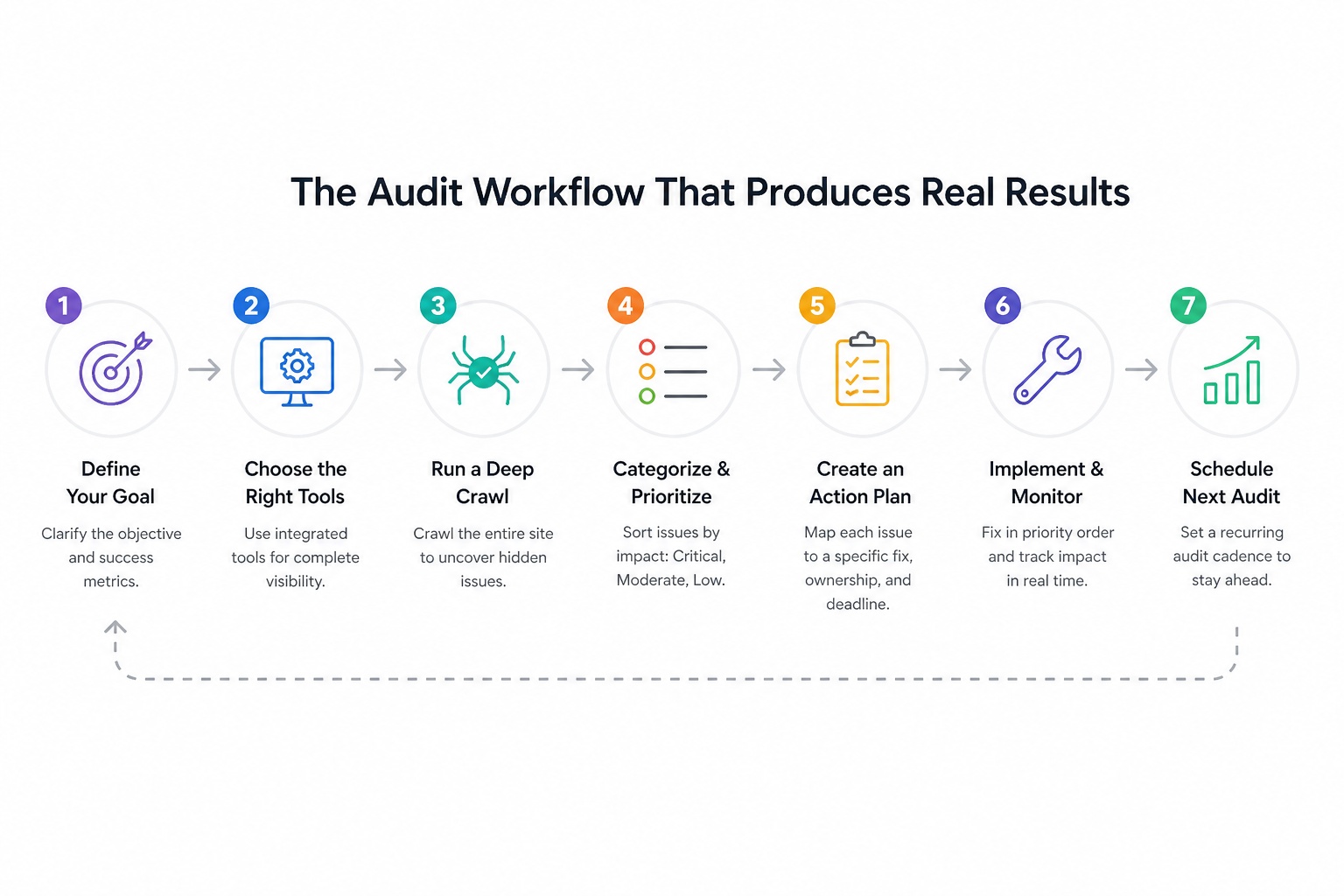
Knowing what to audit and having the right tools only gets you so far. The difference between audits that improve rankings and audits that collect dust is a repeatable, action-oriented workflow. These are the steps that consistently produce measurable results.
Start by defining your goal before touching any tool. Is this audit about recovering lost organic traffic, fixing technical issues that are blocking indexing, improving conversion rates, or preparing for a site migration? Your goal determines which audit type to run first and which metrics you will track to know whether the fixes worked.
Select your tools based on what you need to cover. You need a crawling tool for technical analysis, a keyword tracker for position data, Search Console integration for indexation and query data, and a content performance dashboard. The FluxSERP SEO toolkits consolidate this coverage into one place rather than requiring five separate subscriptions to get a complete picture.
Run the crawl across your entire site, not just top-level pages. Deep crawls consistently surface the most impactful issues hiding in blog posts, product pages, and older content that has not been reviewed recently.
Categorize and prioritize findings into three buckets: critical issues like broken pages and indexing blocks, moderate issues like slow load times and missing meta descriptions, and low-priority issues like minor formatting inconsistencies. Work through them in that order. Fixing low-priority issues before resolving critical ones is a common mistake that wastes time and produces minimal ranking impact.
Create a specific action plan that maps each issue to a fix, assigns ownership, and sets a deadline. Vague findings like "improve page speed" do not produce action. Specific tasks like "compress hero images on five product pages" do.
Implement fixes in priority order and monitor the impact. Watch for ranking shifts, crawl coverage improvements, and changes in organic click-through rates in Search Console. Understanding how to use Search Console effectively is essential at this stage because it gives you the most direct signal of whether the fixes you made are translating into better indexation and ranking.
Schedule the next audit before closing this one. Monthly technical checks for active sites and quarterly full audits keep you ahead of issues rather than chasing them.
Why Proactive Auditing Is the Highest-ROI SEO Activity
Most SEO guides treat auditing as something you do after rankings drop or traffic declines. That framing misses the real value. The highest-return version of auditing is proactive, not reactive.
Consider what happens when you audit proactively. You catch a redirect error before it has been sending crawlers to a dead end for three months. You identify a page that is almost ranking in position twelve and optimize it to position four with two hours of focused work. You find a technical issue that is silently limiting your crawl budget and fix it before it starts costing you indexation.
Compare that to the reactive version. You wait until traffic has already dropped. You spend days trying to diagnose whether the cause is algorithmic, technical, or competitive. You make changes and wait weeks to see whether they produce any improvement. The same amount of work that would have prevented the problem proactively now goes into attempting to reverse it.
Every dollar you spend on content, backlinks, or paid ads performs better when your site's technical and content health is strong. Auditing is the foundation that makes everything else work. The FluxSERP platform is designed to make this kind of continuous site health monitoring practical for teams that do not have a dedicated technical SEO specialist on staff.
Website Auditing and AI Search Visibility in 2026
One dimension of website auditing that was largely irrelevant before 2024 has become increasingly important: your visibility in AI-generated search responses. AI Overviews in Google, citations in ChatGPT, and responses in Perplexity all draw from the same underlying index that traditional search rankings use, but they apply additional filtering based on content structure, topical authority, and citation patterns.
A site with technical crawl errors that prevent efficient indexing will perform poorly in both traditional rankings and AI-generated responses. A site with thin content that does not genuinely answer specific questions will be bypassed by AI summary systems even if it ranks on page one for the target keyword. A site without structured data markup misses eligibility for rich results that increase click-through rates from both traditional and AI-powered search surfaces.
The audit categories that matter most for AI search visibility are technical accessibility, content depth and structure, and internal linking across topic clusters. These are exactly the same categories that matter for traditional SEO, which means a thorough audit serves both goals simultaneously. The AI visibility tracking tool in FluxSERP shows specifically where your content is and is not being cited across AI search surfaces, which gives you a more complete picture than traditional rank tracking alone.
Frequently Asked Questions
How often should a website be audited?
For active sites that publish content regularly or run any paid traffic, a monthly technical check and a quarterly full audit is the right cadence. Sites undergoing major changes like migrations, redesigns, or CMS switches should be audited before and after the change. Waiting until rankings drop to run an audit means the damage has already been done.
What is the most important type of audit to run first?
Run a technical SEO audit first. Technical issues create a ceiling on everything else. If crawlers cannot access and index your content efficiently, no amount of content quality or backlink strength fully compensates. Once you confirm your site is technically healthy, content and on-page audits become much more productive.
Can a non-technical marketer run an effective website audit?
With modern AI-powered audit tools, yes. The tools handle the data collection and surfacing of issues. The marketer needs to understand which category each issue falls into and how to prioritize fixes. The gap between a technical specialist and a non-technical marketer running an audit has narrowed significantly with AI tooling.
How do I know if my audit fixes are actually working?
Monitor Search Console for coverage improvements, watch for ranking shifts in your tracked keywords, and review click-through rates for the pages you fixed. Most technical fixes produce measurable signals within 30 to 60 days. Content improvements take longer because pages need time to be re-crawled and re-evaluated.
Does website auditing affect AI search visibility as well as traditional rankings?
Yes. The same technical and content quality factors that affect traditional rankings affect AI search visibility. AI summary systems draw from the same index and apply similar quality filters. Sites that are technically accessible, topically authoritative, and structured clearly tend to appear more frequently in AI-generated responses as well as traditional results.
What is the biggest mistake businesses make with website auditing?
Treating it as a one-time or reactive project rather than a continuous process. Running one thorough audit and then ignoring site health for a year means you are spending months in a degraded state while problems accumulate. The businesses that compound their SEO advantage over time are the ones that audit consistently, fix proactively, and build on a foundation of ongoing technical health rather than periodic clean-ups.
A website audit is not a punishment or a sign something went wrong. It is the most direct way to understand the current state of your site's performance and the gap between where you are and where you could be. Done regularly and acted on systematically, it is the foundation that makes every other SEO effort compound rather than plateau.
Find Out What's Actually Hurting Your Rankings Right Now
FluxSERP audits your site's technical health, tracks rankings across Google and AI search, and shows you exactly where your competitors are gaining ground so you can prioritize the fixes that matter most.
Start for Free
Catalin Dinca
Written by Catalin Dinca